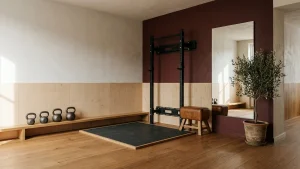
A mirror wall is the highest-impact thing you can add to a home gym and the easiest to do badly. Get the glass too thin and it bows, so every reflection has a slight wave in it. Mount it on an uneven wall and it does the same. Put the lighting in the wrong place and you look worse in it than you do in life, which affects whether you use the room.
None of that is difficult to avoid. It just has to be decided before you order glass.
How Much Mirror You Actually Need
Less than the photographs suggest.
| Use | Width | Height |
|---|---|---|
| One person, form checks while lifting | 5–6 ft | 5–6 ft |
| One person, floor work and standing | 6–8 ft | 6 ft |
| Two people side by side | 10–12 ft | 6 ft |
| Dance, barre or full studio | Full wall | Floor to 7 ft |
A single 60 by 72 inch panel covers one person completely for almost any purpose, and that is the size most home gyms should buy. Commercial gyms mirror entire walls because thirty people are using the room at once, not because it is better.
Standard panel sizes are 48 by 72 and 60 by 72 inches. Buying stock sizes rather than custom cuts saves a meaningful amount of money, so design the layout around them where you can.
Mirror on one wall only. Two facing mirror walls produce an infinite corridor effect that is disorienting in a small room and impossible to photograph.
Glass Thickness, Safety and the Legal Bit
The two specifications that matter, and the second one is a safety issue.
Thickness: buy quarter-inch (6 mm). Thinner glass — the 1/8 inch or 3 mm panels sold cheaply online — flexes under its own weight and against any imperfection in the wall. The result is a visible wave that distorts your reflection, and it is the single most common complaint about DIY mirror walls. Quarter-inch glass is roughly twice the price and it is not optional for a panel this size.
Safety backing: insist on it. A vinyl or film backing applied to the rear of the mirror holds the fragments together if the glass breaks. Standard mirror glass is annealed, not tempered — true tempered mirror exists but is uncommon and expensive, because glass cannot be cut after tempering. Safety-backed annealed glass is the normal specification for gyms, and many commercial building codes require it in exercise spaces.
This matters in a room where heavy objects get dropped. A 60 by 72 inch mirror weighs roughly 55 pounds and, without backing, breaks into large edged sheets. Ask the supplier explicitly for safety-backed or CAT II mirror. If they do not know what you mean, buy elsewhere.
Weight to plan for: quarter-inch mirror runs about 3.3 pounds per square foot. A 5 by 6 foot panel is around 100 pounds. That is a two-person lift and it dictates the mounting method.
Gym Mirrors vs. Ordinary Mirrors
There is a real difference, and it is not just marketing.
Purpose-made gym mirrors are quarter-inch, safety-backed, and usually have polished or seamed edges so panels can butt together with a minimal joint. They are sold as bare glass, without a frame.
Bathroom and decorative mirrors are often thinner, frequently framed, and sometimes have a slight tint or an antiqued finish that is unhelpful for form checking.
Low-iron glass is the upgrade. Ordinary float glass has a faint green cast, visible at the edges and in large panels. Low-iron mirror is noticeably more neutral and costs perhaps 20 to 30 percent more. Worth it in a room where you look at yourself deliberately; unnecessary elsewhere.
Edges are a specification too. Seamed edges are sanded just enough to be safe to handle and are meant to be hidden by a channel or butted against another panel. Polished edges are ground smooth and slightly rounded, and they are what you want on any edge that stays visible — a single panel with polished edges reads as deliberate rather than unfinished. Beveled edges belong on decorative mirrors, not on a gym panel, because the bevel distorts the reflection at the perimeter.
Humidity, Sweat and Black Edges
The failure mode nobody warns about, and it is entirely preventable.
Mirror silvering is protected by a copper layer and paint on the back, and both are attacked by moisture and by ammonia. In a gym — a warm, humid room where you sweat and then wipe the glass — that produces desilvering: dark creeping blotches that start at the edges and spread inward. Once it starts, it cannot be repaired.
Three habits prevent it entirely:
- Never spray cleaner directly on the glass. It runs down and wicks into the edge. Spray the cloth instead.
- No ammonia and no vinegar. Standard blue window cleaner is an ammonia product. Use a dedicated mirror or glass cleaner, or plain water on microfiber.
- Ventilate. The same dehumidification that protects a basement floor protects the mirror, and 40 to 55 percent relative humidity is the target either way.
Leave a small gap behind the panel rather than sealing it airtight against the wall. Trapped moisture behind a mirror is the other common cause of edge failure.
Mounting Options, Compared
| Method | Holds | Removable | Best for |
|---|---|---|---|
| J-channel bottom + clips top | Excellent | Yes, with care | Most installations. The standard |
| Mirror mastic (adhesive) | Excellent | No — destroys drywall | Permanent installs, uneven walls |
| Mastic plus J-channel | Best | No | Large panels, commercial standard |
| Z-clips / French cleat | Very good | Yes | Heavy single panels, rentals with permission |
| Leaning, floor-standing | Adequate | Yes | Rentals, low commitment |
The standard approach for a large panel is a J-channel screwed into studs along the bottom to carry the weight, plus clips at the top to hold the panel to the wall, with adhesive between if the install is permanent.
Two things to get right:
Fix into studs, not drywall anchors. A hundred pounds of glass on toggle bolts is not a risk worth taking.
Never use ordinary construction adhesive. Solvents in general-purpose adhesives attack the silvering on the back of the mirror and produce dark blotches within months. Use mirror mastic specifically.
Getting the Height Right
Different uses want different bottom edges.
For lifting, the bottom edge at 12 to 20 inches above the floor, with the top at 6’6″ to 7′. You need to see your hips and knees in a squat, not your feet.
For floor work, pilates and stretching, start lower — 6 to 12 inches — so you can see yourself lying down.
For dance or barre, floor to 7 feet, full stop.
Above a baseboard is the practical constraint in most rooms. Either remove the baseboard and run the mirror to the floor, or set the bottom edge on top of it and accept the small shelf that creates. Removing it looks better and takes an hour.
The Wall Behind It Has to Be Flat
This is the step people skip and then regret.
Quarter-inch glass conforms slightly to whatever it is fixed to. A bow of more than about an eighth of an inch across eight feet will be visible in the reflection.
Before ordering glass, hold a long straightedge — a level, a straight board — against the wall horizontally and vertically. Look for gaps.
If the wall is out:
- Shim behind the mounting points to bring the panel onto a true plane
- Use adhesive dabs of varying thickness to bridge low spots, which is why mastic installs tolerate worse walls than clip installs
- Add a plywood backer across the whole area, screwed into studs and skimmed flat, then mount to that. This is the reliable answer in an old house and it costs very little.
Also check the wall is plumb. A mirror on a leaning wall makes everyone standing in front of it look like they are falling over.
Lighting a Mirror Wall
Bad mirror lighting is the reason some gyms feel unpleasant to be in.
Do not put downlights directly above the mirror. Light from straight overhead casts shadows into the eye sockets and under the jaw, and it makes anyone look tired and unwell.
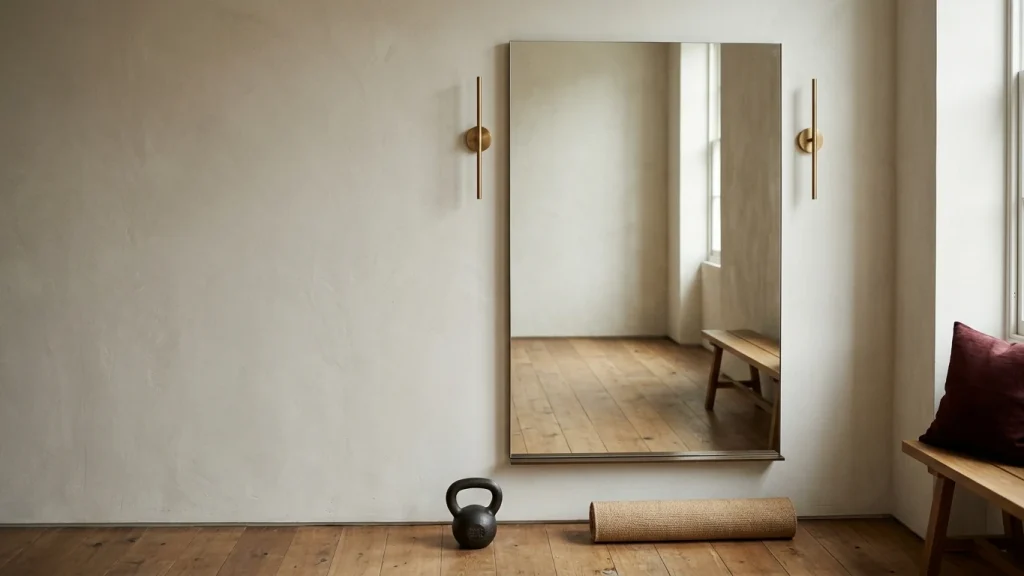
Light from the sides, or from behind the viewer, or bounced off the opposite wall. Sconces flanking the mirror at roughly face height are the flattering solution, exactly as they are in a bathroom.
Avoid reflecting a bare fixture. Stand where you will stand and check what the mirror throws back. A visible bright source in the reflection is distracting during every set.
Warm and dimmable, around 3000K. The mirror doubles the apparent light in the room, so you will need less than you think.
Leaning Mirrors and Rental-Friendly Options
If mounting is not an option, the leaning mirror is a genuinely good answer rather than a compromise.
Size: 30 by 70 inches or larger. Below that you cannot see enough of yourself for form checks.
Anchor it to the wall. A leaning mirror is a serious tip-over hazard, particularly with any impact in the room. Every quality mirror comes with a strap and anchor, and it should be fixed into a stud. This is not optional in a room where things get dropped.
Two leaning mirrors side by side give you close to the coverage of a mounted panel at a fraction of the commitment, and they can move with you.
Frameless with a polished edge reads as architectural. A thin black or brass frame reads as furniture. Both work; heavy ornate frames do not.
Mirror Walls Outside the Gym
The same technique applies elsewhere, and a mirror wall is one of the few interventions that genuinely makes a small room feel larger.
In a narrow hallway, a mirror along one long wall roughly doubles the perceived width.
Opposite a window rather than facing a blank wall — a mirror reflecting a view or daylight adds something; a mirror reflecting a wall just adds a wall.
In a dining room, a full-height panel behind a sideboard is a long-standing European move and it looks considerably more expensive than it is.
Not opposite a bed, and not in a position where you catch yourself unexpectedly walking through a room. Mirrors are best when you choose to look at them.
Common Questions
What size mirror do I need for a home gym? A single panel of 60 by 72 inches covers one person for any purpose. Six to eight feet of width is comfortable for one, and ten to twelve for two people training side by side.
How thick should a gym mirror be? Quarter-inch, or 6 mm. Thinner glass flexes and produces a visible wave in the reflection, which is the most common complaint about cheap mirror walls.
Do gym mirrors need safety backing? Yes. Safety backing holds the fragments together if the glass breaks, and it is standard specification in exercise spaces where heavy objects get dropped. Ask for safety-backed mirror specifically.
How do you attach a mirror to a gym wall? A J-channel screwed into studs along the bottom to carry the weight, plus clips at the top, with mirror mastic between them for permanent installations. Fix into studs, never into drywall anchors alone.
How high off the floor should a gym mirror be? Twelve to twenty inches for lifting, which lets you see hips and knees in a squat. Lower — six to twelve inches — if you do floor work and want to see yourself lying down.
How much does a gym mirror wall cost? Roughly $5 to $12 per square foot for the glass itself, and $12 to $25 per square foot installed professionally. A single 5 by 6 foot panel typically runs $200 to $500 supplied, more for low-iron glass.