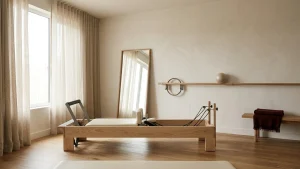
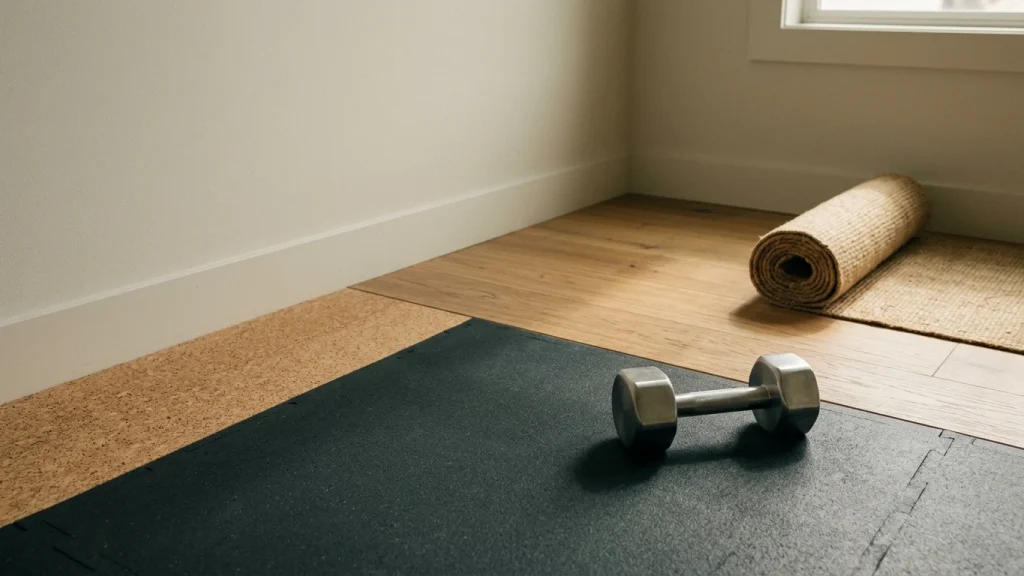
The floor is the first purchase and the one people most often get wrong in both directions — either buying commercial rubber for a room where nobody drops anything, or buying foam tiles for a room with a barbell in it.
What you need depends almost entirely on two things: whether weights get dropped, and what is underneath. Everything else is preference.
What the Floor Has to Do
Five jobs, and not every room needs all five.
Protect the subfloor from dropped weights, dragged equipment and the point loads under a rack.
Protect the equipment. A dumbbell dropped on concrete damages the dumbbell.
Absorb noise and impact. This is the dominant concern in an apartment, an upstairs room, or anywhere above a bedroom.
Provide grip. For lifting, for burpees, for anything where your hands or feet need to stay put.
Be comfortable to sit and lie on. Underrated. If floor work is part of your routine, a surface you resent is a surface you avoid.
Rank those five for your own room before shopping. A pilates and mobility room prioritizes comfort and grip and can ignore impact protection entirely. A room with a barbell reverses that.
The Options, Compared
| Material | Cost per sq ft | Good at | Bad at |
|---|---|---|---|
| Rubber rolls | $2–5 | Everything durable, seamless coverage | Weight, smell, awkward to handle |
| Rubber interlocking tiles | $2–6 | DIY install, moving later | Seams shift under load |
| Horse stall mats | $1–2 | Cheapest heavy-duty option | Very heavy, strong smell, limited sizes |
| EVA foam tiles | $0.50–2 | Cheap, light, warm | Dents permanently, unstable underfoot |
| Cork | $3–8 | Warmth, quiet, comfort, grip | Not for dropped weights |
| Vinyl plank | $2–6 | Looks like a room, waterproof | Hard, no impact absorption |
| Turf strip | $4–8 | Sled work, sprints, a defined zone | Only useful as a strip |
| Plywood + rubber platform | $150–400 total | Deadlifts, olympic lifting | Fixed location, DIY build |
The most common good answer for a mixed home gym: rubber under the lifting zone, something warmer everywhere else. Wall-to-wall black rubber is a commercial specification and most home rooms do not need it.
Rubber: Rolls, Tiles and Mats
Three formats of essentially the same material.
Rolls are 4 feet wide, come in lengths up to 50 feet, and give you a near-seamless surface. They are the best-looking and best-performing option and they are genuinely difficult to handle — a 25-foot roll of half-inch rubber weighs over 200 pounds and does not go around corners. Plan the delivery route.
Interlocking tiles are 2 by 2 or 3 by 3 feet, install without tools, and can be taken up and moved. The trade-off is seams, which can lift and shift under a rack or a treadmill. Fine for general use, less good under anything heavy that moves.
Horse stall mats are the budget legend of the home gym world: 4 by 6 feet, three-quarter inch thick, about $50 each from farm supply stores, which is roughly half the price per square foot of purpose-made gym rubber. They are also 100 pounds each, cut with difficulty, and smell strongly at first. For a garage gym where appearance is secondary, they are hard to beat.
Recycled versus virgin rubber. Most gym rubber is recycled tire crumb, identifiable by the colored flecks. It is cheap, tough and it smells. Virgin rubber and EPDM cost considerably more, come in real colors, and smell very little. In a garage, buy recycled. In a spare bedroom, the upgrade is worth considering.
The Smell Problem Nobody Warns You About
This is the most common regret and it is entirely predictable.
Recycled tire rubber off-gasses. In an open garage it is noticeable for a week or two. In a closed, heated, upstairs room it can be genuinely unpleasant for months, and it gets stronger when the room warms up — which is exactly when you are in it, breathing hard.
What actually helps:
- Air it out before installing. Lay the rubber outside, or in a garage with the door open, for one to two weeks. This does most of the work and almost nobody does it.
- Ventilate afterward. A window open for the first few weeks, and an extractor if the room has no window.
- Wash it. A scrub with warm water and a little dish soap removes surface residue and helps more than expected.
- Buy virgin rubber or EPDM if the room is small, enclosed and part of the house. It costs perhaps twice as much and it does not have this problem.
- Buy vulcanized rolls rather than crumb tiles. Denser, less surface area, less outgassing.
If anyone in the house is sensitive to smells or has asthma, treat this as a real constraint rather than an inconvenience.
Cork, Vinyl and the Quieter Alternatives
Cork is the best surface for a room used mainly for yoga, pilates, mobility and bodyweight work. Warm underfoot, quiet, slightly resilient, naturally grippy, and comfortable to sit on without a mat. It will dent under a dropped dumbbell and it is not the right choice under a rack, but for everything else it is more pleasant than rubber by a wide margin. Around $3 to $8 per square foot.
Vinyl plank looks like wood, costs little, and survives sweat and spills. It is hard and offers no impact absorption, so it wants a rug or mat zone over it. Its real advantage is that the room still reads as part of the house when the equipment is put away.
Rubber-backed carpet tile is a quiet, warm option used in a lot of commercial cardio zones. It handles treadmills and bikes well, feels domestic, and is easy to replace a section of. It is poor under weights and it holds smells over time.
Engineered wood or existing hardwood with a rug on top is a legitimate answer for a light-use room, and it is what most well-designed home gyms in photographs actually have.
Flooring Over Concrete
Concrete is the easiest subfloor and it still has two traps.
Moisture. Concrete slabs, particularly on grade or below grade, transmit water vapor. Trapped under rubber or vinyl, that produces mildew and adhesive failure. Test before you cover it: tape a two-foot square of clear plastic sheet tightly to the slab and leave it 48 to 72 hours. Condensation underneath, or a dark patch on the concrete, means you need a vapor barrier.
Unevenness. Garage slabs are usually sloped toward the door on purpose, and old basement slabs are rarely flat. Rubber follows whatever is beneath it. A rack on a sloping floor is a real problem, not a cosmetic one. Self-levelling compound is the fix and it is not expensive for a small area.
Thickness over concrete should go up, not down. Concrete has no give at all, so the rubber is doing all the work. Half-inch minimum where weights are handled, three-quarter inch where they are dropped.
Flooring Over Wood, Carpet and Upstairs Rooms
Over existing hardwood, put down a protective layer even for light use — felt or a thin foam underlay under rubber, so grit does not grind into the finish.
Over carpet works better than people expect for cardio and light equipment, but it makes a rack unstable and it makes rubber tiles float and shift. Low-pile carpet with rubber tiles on top is acceptable; anything plush is not.
Upstairs rooms need three things checked. Floor load, first — a rack with 400 pounds of plates plus a person is a significant point load, and it should sit across joists rather than between them. Impact noise, second — dropping weights on an upper floor transmits into the structure and no amount of rubber fully solves it. And whether the room below is somewhere anyone needs to be.
The honest advice for upstairs: do not drop weights. Use dumbbells and machines, lower loads under control, and put the heavy work in a basement or garage.
How Thick, and Where
| Use | Thickness |
|---|---|
| Cardio, yoga, bodyweight | 1/4 in (6 mm) |
| General training, light dumbbells | 3/8 in (10 mm) |
| Moderate weights, rack, bench | 1/2 in (12 mm) |
| Weights set down hard | 3/4 in (20 mm) |
| Olympic lifting, dropping loaded bars | Platform: plywood layers plus 3/4 in rubber |
Zoning saves money and looks better. Half-inch rubber in a 8 by 8 foot lifting area, and cork, vinyl or a rug across the rest of the room, costs less than covering everything in three-quarter inch and produces a far more pleasant space.
A deadlift platform is the correct solution for anyone dropping a loaded barbell. Two layers of three-quarter inch plywood with rubber on the outer thirds and a hardwood or thinner rubber strip in the middle. It costs a couple of hundred dollars in materials, protects everything beneath it, and it is dramatically more effective than deep rubber everywhere.
Installing It: What Goes Wrong
Let it acclimatize. Rolls and tiles arrive rolled or stacked and hold that shape. Lay them out flat in the room for 24 to 72 hours before final fitting, or every seam will curl.
Dry-fit the whole floor first. Cut nothing until the layout is set.
Cutting rubber destroys blades. Use a sharp utility knife, a long metal straightedge, several passes rather than one deep one, and buy a pack of blades. Change them far more often than feels reasonable — a dull blade tears the edge and the seam shows forever.
Leave a small expansion gap at the walls, about a quarter inch. Rubber moves with temperature, and a floor fitted tight in winter will buckle in August in a garage.
Do not glue unless you are certain. Loose-laid rubber stays put under its own weight in nearly every home installation, and it can be lifted and moved. Glued rubber is permanent and removing it takes the concrete surface with it.
Seams: overlap two pieces slightly and cut through both at once with the straightedge. The two cut edges then match exactly, which is far more reliable than measuring.
Common Questions
What is the best flooring for a home gym? Half-inch rubber under the lifting area and something warmer — cork, vinyl plank or a low-pile rug — across the rest. Wall-to-wall rubber is a commercial specification most home gyms do not need.
How thick should home gym flooring be? A quarter inch for cardio and floor work, three-eighths for general training, half an inch under a rack or bench, and three-quarters where weights get set down hard. Dropping loaded barbells calls for a plywood-and-rubber platform rather than thicker flooring.
Can I put gym flooring over carpet? Over low-pile carpet, yes, for cardio and light equipment. A rack will be unstable and tiles will shift. Plush carpet is not a suitable base for any gym flooring.
Do horse stall mats work for a home gym? Yes, and they are the cheapest heavy-duty option at roughly half the price of purpose-made gym rubber. They weigh about 100 pounds each, are hard to cut, and smell strongly at first, so air them out before bringing them indoors.
How do I stop new gym flooring from smelling? Air the rubber outdoors or in an open garage for one to two weeks before installing, wash it with warm soapy water, and ventilate the room for the first few weeks. For a small enclosed room, buy virgin rubber or EPDM instead of recycled tire crumb.
Do I need a vapor barrier over a concrete floor? Test first by taping a square of plastic sheet to the slab for two to three days. If moisture appears underneath, yes. Below-grade basements and slabs on grade are the usual cases.