
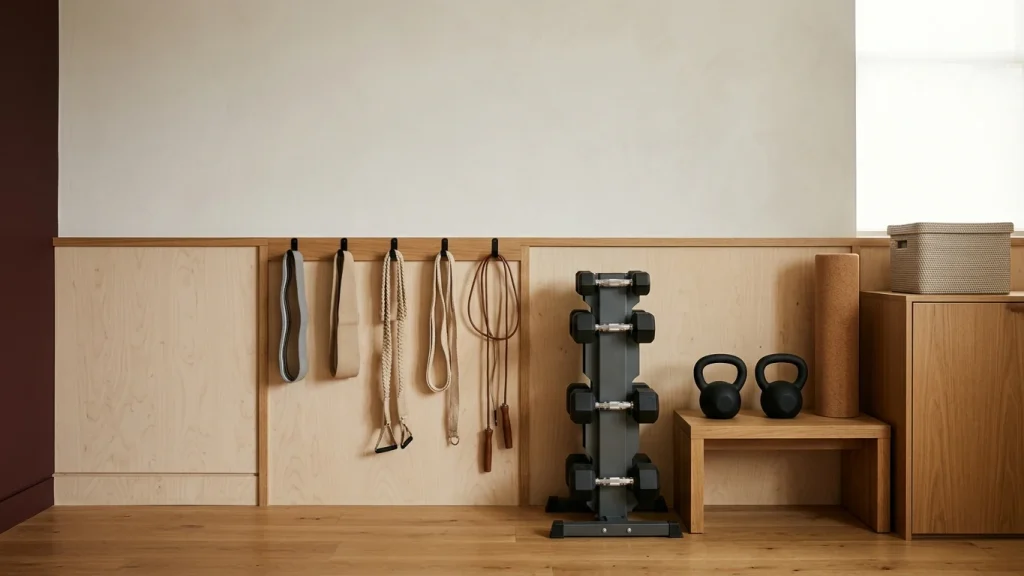
Every home gym looks good on the day it is finished and most look like a garage six months later. The equipment does not change. What changes is that nothing has a place, so everything ends up on the floor.
Storage is the difference between a room you train in and a room you step over. It is also the cheapest part of the whole project, which makes it the strangest thing to skip.
Why Gym Storage Fails
Four predictable reasons, and they compound.
Nothing has a home. If a kettlebell does not have one specific place it belongs, it belongs wherever it was last put down. Every item without an assigned spot becomes floor clutter within a week.
The storage is further away than the floor. A rack in the corner loses to the floor at your feet every single time. Storage has to be closer to where you use the thing than the floor is.
It was bought before the equipment was. Storage sized for what you imagined you would own rarely fits what you actually bought.
It is open, in a room that is also something else. A gym in a spare bedroom or a living space needs some storage that closes. Open shelving full of black rubber is fine in a garage and reads as chaos anywhere else.
Start With What You Actually Own
Before buying a single rack, write the list. It takes ten minutes and it changes what you buy.
| Category | Typical items | Storage type it needs |
|---|---|---|
| Heavy, dense | Dumbbells, kettlebells, plates | Floor-standing steel or stud-mounted steel |
| Long | Barbells, bars, foam rollers | Vertical holders or horizontal wall hooks |
| Soft, bulky | Mats, boxes, bench pads | Vertical leaning storage or a corner |
| Small, tangling | Bands, straps, ropes, cables | Pegboard, hooks, or a closed bin |
| Consumables | Chalk, tape, wipes, towels | Closed box near the door |
| Rarely used | Seasonal gear, spare parts | Out of the room entirely |
The last row is the one people miss. Anything used less than monthly should not live in the gym. It occupies prime storage and it makes the room feel full.
Weigh the total, too. Six pairs of dumbbells plus 300 pounds of plates is roughly 700 pounds of steel that has to be supported by something — which is the whole reason mounting matters later in this article.
Dumbbell Storage
The single most searched storage problem in a home gym, and the answers differ sharply by what you own.
Adjustable dumbbells ship with a cradle or a stand. Use it. It is the entire storage solution, it costs nothing extra, and it is the strongest argument for adjustables in a small room.
A vertical dumbbell tower holds three to five pairs in about a two-foot square footprint. Best value per square foot for a fixed set.
A horizontal two- or three-tier rack is stable, easy to load, and it consumes four to six feet of wall. Choose it if you have the wall and you are lifting heavy enough that lifting a 70-pound dumbbell to a top shelf is unwelcome.
Wall-mounted dumbbell shelves clear the floor entirely and look considerably better. They must go into studs, and the load ratings matter — check the manufacturer’s per-shelf rating against what you will actually put on it.
A flat tray or low bench for two or three pairs. In a room that is also a living space, this reads far calmer than a rack.
| Storage | Capacity | Footprint | Cost |
|---|---|---|---|
| Included adjustable stand | 1 pair | 2 × 1.5 ft | Included |
| Vertical tower | 3–5 pairs | 2 × 2 ft | $100–250 |
| 3-tier horizontal rack | 5–10 pairs | 4–6 × 2 ft | $200–500 |
| Wall-mounted shelf | 2–4 pairs | Wall only | $80–200 |
| Rack-mounted storage attachment | 2–3 pairs | None extra | $100–200 |
Heaviest at the bottom, always. On a tiered rack the top row is where you reach with the least leverage, so it takes the lightest pair.
Plates, Barbells and Bars
Steel is heavy and it damages whatever it rests against, so this is where the storage has to be real.
Weight trees are the default: a central post with pegs, sorted by size. Cheap, effective, mildly ugly, and they need floor space near the rack.
Rack-mounted plate pegs are better if you own a rack. They add nothing to the footprint, they put the plates within arm’s reach of the bar, and they add loaded weight to the rack’s base, which improves stability.
Sort plates by size, heaviest inboard. Loading a bar is faster and you stop hunting for the second 25.
Barbells stored vertically in a floor holder or a wall bracket take up about one square foot for three or four bars. Horizontal wall hooks are the alternative and they display the bar nicely, but they need clear wall and they must be into studs.
Never leave a loaded bar racked long-term. It stresses the bar and the rack, and in a house it is a hazard for anyone who does not train.
Protect the floor under any plate storage. A stack of iron on rubber over a wood floor still leaves marks. A dedicated mat or a plywood pad under the tree solves it.
Small Equipment That Otherwise Tangles
This is the category that visually ruins rooms — bands, straps, ropes, jump ropes, cables, loops.
A pegboard or steel slat wall above waist height. Everything hangs, everything is visible, nothing tangles, and it takes almost no depth.
A simple rail with six hooks does most of the same job for $30.
Closed bins for the rest. Chalk, tape, gloves, wipes, spare pins. One box, near the door, closed.
Mats and foam rollers store vertically, standing in a corner or in a tall basket. Rolled mats laid flat on the floor are trip hazards and they never get put away.
Jump ropes on a hook, not in a bin. They knot in a bin, every time.
Label nothing. In a domestic room, labels read as a warehouse. If a bin needs a label, it has too much in it.
Wall Systems: Pegboard, Slat Wall and French Cleat
If you are going to do one structural thing, do a wall.
Plywood over the studs, full or half height. Three-quarter-inch birch ply screwed into every stud gives you a wall you can mount anything to, anywhere, without hunting. Sealed or painted a warm neutral, it also looks better than drywall with holes in it. This is the highest-value wall decision in a home gym.
Steel slat wall or gym-specific track systems. Purpose-made, rated for real loads, and modular — hooks and shelves move as your equipment changes. More expensive, and it looks like equipment rather than furniture.
Traditional pegboard is fine for bands, straps and light items and it is not appropriate for anything heavy. Standard hardboard pegboard is not a load-bearing surface.
French cleats are the quiet, custom option: a beveled rail across the wall and matching beveled backs on shelves and holders. Everything is removable and repositionable, the load goes straight into the studs, and in wood it looks like joinery rather than gym gear.
Storage in a Room That Is Not Only a Gym
Spare bedrooms, offices, living rooms and finished basements all need storage that hides.
One closed cabinet does most of the work. A simple wardrobe, a credenza, or an IKEA-type cabinet holds mats, bands, weights, towels and everything else visually noisy. When the doors are shut the room is a room again.
A storage bench for the small items, which also serves as a step or a seat.
Baskets with lids for soft items. Open baskets full of straps look like open baskets full of straps.
Choose equipment you do not mind seeing. A wood rowing machine, kettlebells in cast iron, a leather-topped bench, adjustable dumbbells in a cradle. Everything else goes behind a door.
Storage by the door, not in the corner. Things get put away on the way out. Storage placed where you exit is used; storage in the far corner is not.
Mounting: Studs, Ratings and Anchors
The section that matters most and gets the least attention, because failure here is not a tidiness problem.
Find the actual studs. A magnetic stud finder locates the screws in the drywall and is more reliable than an electronic one. Confirm with a small pilot hole before committing. Studs are typically 16 inches on center, sometimes 24 in newer construction.
Use lag screws, not drywall screws. Structural mounting is 5/16 or 3/8 inch lag bolts with washers, sunk at least 1.5 inches into solid framing.
Drywall anchors do not hold weight equipment. No toggle, no plastic sleeve, no adhesive hook is rated for dumbbells or plates. If it is not in a stud, it is not mounted.
Masonry and concrete need proper sleeve or wedge anchors and a hammer drill. Plastic plugs in concrete block will pull out under a shock load.
Respect the stated rating, then halve it for shock loads. A shelf rated at 200 pounds is rated for 200 pounds sitting still, not for a 70-pound dumbbell being dropped onto it from six inches up.
Do not mount heavy storage on a wall shared with a bedroom if you can avoid it. Sound transmits directly through the framing.
Check the bolts once a year. Vibration loosens things, and a wall-mounted rack of steel is one item you want to be certain about.
Keeping It Organized After Week Three
The system is not the shelving. It is the reset.
Put it back before you leave the room. One rule, and it is the only one that reliably works. Two minutes at the end of a session beats an hour on a Saturday.
Zone the room and keep the zones. Lifting area, cardio area, mat area, storage wall. Things drift back to where they belong when there is a where.
Keep the middle of the floor empty. Permanently. It is the visual cue that tells you the room is in order, and it is the first thing that goes.
Audit twice a year. Anything untouched in six months leaves the room. Home gyms accumulate abandoned purchases faster than almost any other space in a house.
Restock consumables in one place. Chalk, tape, wipes and spare batteries in one closed box means you notice when something runs out.
Photograph the room when it is right. It sounds trivial. It is the fastest way to see what “reset” actually means when you are tired at the end of a session.
Common Questions
What is the best way to store dumbbells at home? A vertical tower for three to five pairs in a two-foot square, a horizontal tiered rack if you own more and have the wall, or a stud-mounted shelf to keep the floor clear. Adjustable dumbbells should simply live in their included cradle. Always put the heaviest pair on the bottom.
How do you store weight plates in a home gym? On a weight tree near the rack, or on rack-mounted plate pegs if you own a rack — pegs add no footprint and the extra loaded weight improves rack stability. Sort by size with the heaviest inboard, and protect the floor underneath.
Can you mount gym storage on drywall? Not into drywall alone. Anchors, toggles and adhesive hooks are not rated for weight equipment. Mount into studs with 5/16 or 3/8 inch lag screws, or fix a plywood layer across the studs first and mount to that.
How do I organize a small home gym? Get everything off the floor and onto a wall system, use one closed cabinet or bench for small items, store mats and rollers vertically, put the storage by the door rather than in a corner, and keep the middle of the floor permanently clear.
What should I use for band and strap storage? A pegboard, a steel slat wall, or a simple rail with hooks above waist height. Anything soft that hangs stays untangled and visible. Bins are the reason bands end up knotted.
How do I keep a home gym from becoming a dumping ground? Give every item one assigned place, reset the room before you leave it rather than later, keep the storage closer than the floor, and audit twice a year — anything untouched in six months goes out of the room.