The constraint is almost never the total square footage. It is that the room also has to be a guest room, or that the neighbors are directly below, or that the only free wall has a radiator on it.
Small home gyms work when the equipment is chosen for footprint rather than for capability, and when the room can be reset in about five minutes. Here is how to make one out of a spare bedroom, a corner, or an apartment.
How Small Is Actually Too Small
Less small than you would guess.
| Space | What fits |
|---|---|
| 5 × 7 ft corner | Mat work, bands, kettlebells, adjustable dumbbells |
| 7 × 9 ft | All of the above plus a folding bench and a spin bike |
| 8 × 10 ft | Wall-mounted folding rack, bench, dumbbells, clear floor |
| 10 × 12 ft (typical spare bedroom) | Rack, bench, cardio machine, mat zone, storage |
| 12 × 14 ft+ | Two people, or a full rack with room around it |
The one dimension that cannot be negotiated is ceiling height for overhead work. Pressing a barbell or a dumbbell overhead while standing needs about eight feet for most adults. A pull-up bar needs enough clearance above it to get your chin over. Under seven and a half feet, plan around it rather than into it.
Clear floor beats total floor. A 10 by 12 room with a bed, a dresser and a chair in it has less usable space than an 8 by 10 room with nothing in it.
The Spare Bedroom Layout
A standard American spare bedroom of roughly 10 by 12 is enough for a complete gym. The layout that works:
The rack goes on the wall with studs you can find and a floor you can load — ideally an exterior or load-bearing wall, running across the joists rather than parallel to them.
Cardio goes near the window for airflow, facing whatever screen you use.
The mat zone takes the middle, which stays clear.
Storage goes by the door, so things get put away on the way out rather than left where you finished.
The mirror goes opposite or beside the window, never facing it — you want light on you, not behind you.
Leave the door swing clear, and leave one path from the door to the middle of the room that never has anything on it.
Equipment That Earns Its Footprint
Ranked by capability per square foot.
Adjustable dumbbells. Two objects instead of twenty, covering 5 to 50 or 90 pounds depending on the model. The single highest-value purchase for a small room. $300 to $800.
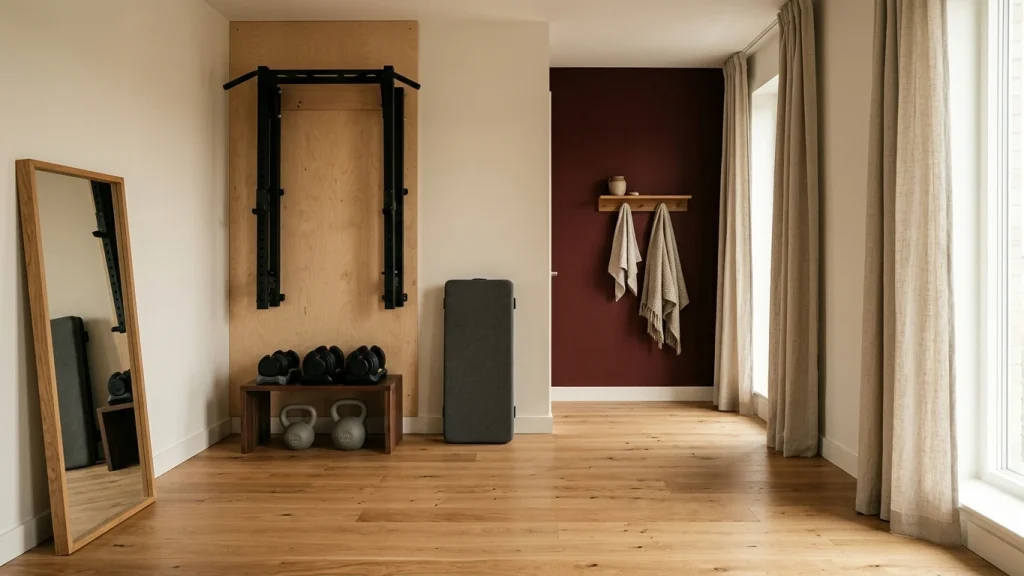
A wall-mounted folding rack. Folds flat to four or five inches against the wall and swings out for use. Requires solid stud mounting and a ceiling above eight feet. This is the piece that makes a spare bedroom into a real gym. $400 to $900.
Two or three kettlebells. Enormous exercise range, no footprint, and they look better than most equipment.
A folding or adjustable bench. Stores upright against a wall.
A suspension trainer. Door anchor or ceiling mount, weighs two pounds, folds into a bag.
Resistance bands with a door anchor. The most capability per dollar and per inch in existence.
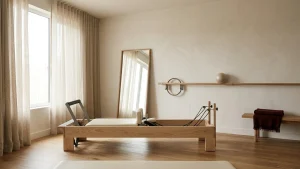
A rowing machine that stands on end. Full-body cardio that occupies about two square feet when stored. Water rowers in wood are the version people leave out in the open on purpose.
A jump rope, sliders and a mat. All of it fits in a basket.
What to Skip in a Small Room
Multi-station machines. Large, visually heavy, and they replace things you can do with a rack and a bench.
A full dumbbell set. Ten pairs on a rack consumes an entire wall to do what one pair of adjustables does.
A large treadmill, unless running is genuinely your main activity. They are the biggest footprint per hour used of anything in a home gym, and folding ones are still large folded.
A permanently inflated exercise ball. It takes up a cubic yard and gets used for four exercises.
Leg press, Smith machine, cable crossover. Commercial-scale equipment in a domestic room.
A second cardio machine. Almost nobody uses both.
Making a Room Do Two Jobs
Most small gyms share a room, and the sharing is what determines whether it lasts.
Gym and guest room. A wall bed is the clean solution and it is expensive. The cheaper version is a folding or inflatable bed in the closet and a rack that folds. Accept that the room is a gym for fifty weeks a year.
Gym and office. Awkward, because a desk is a fixed object with a chair in front of it. It works if the desk goes on the wall opposite the equipment and the middle stays clear. It does not work if the gym is the thing that moves.
Gym and living space. Requires equipment you are willing to look at every day, which narrows the list to kettlebells, a wood rower, a bench that reads as furniture, and storage that closes.
The five-minute rule. Whatever the arrangement, it must be possible to convert the room in about five minutes. Anything that takes fifteen will stop happening within a month, and the room reverts to one use — usually the wrong one.
Apartment Constraints: Noise, Floors and Neighbors
The specific problems of training in a building with people under you.
Impact noise is the whole issue. Dropping weights, jumping, and running on a treadmill all transmit into the structure. Rubber flooring helps with the sharp sound; it does very little for the low-frequency thud, which is what neighbors actually complain about.
The practical answers: do not drop anything, lower every weight under control, replace jumping movements with step-ups and low-impact variants, and put a dense mat plus a felt underlay under any cardio machine.
Check your lease. Some buildings restrict floor loads or prohibit free weights outright.
Time of day matters more than equipment. The same session at 7 a.m. and at 10 p.m. produces very different responses from the apartment below.
Delivery is a real constraint. A rack, a rower or 200 pounds of rubber flooring arriving at a third-floor walk-up is a problem to solve before ordering, not after.
Bands, suspension trainers, kettlebells and bodyweight work are close to silent and cover most of what anyone needs. An apartment gym built around those, plus a bike, is genuinely complete.
Vertical Space Is the Space You Have
In a small room, everything that leaves the floor buys you square footage.
Wall-mounted folding rack — the biggest win, as above.
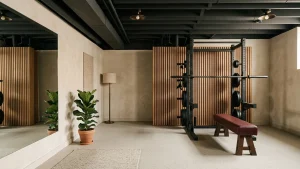
Wall storage for plates, kettlebells and bars. Steel racks mounted into studs, which keep the floor clear and, in matte black on a wood wall, look intentional.
A pegboard or slat wall for bands, ropes, straps and small items. It is the difference between a room and a room with things on the floor of it.
Ceiling-mounted or wall-mounted pull-up bar, fixed into joists rather than an over-door bar, which limits what you can do and marks the frame.
Vertical mat and roller storage by the door.
Shelving above head height for towels and anything used rarely.
Making a Small Room Feel Bigger
The same principles as any small room, with one gym-specific addition.
A mirror on one wall. It genuinely doubles the perceived depth, and in a gym it is functional as well.
Light floor, light walls. Black rubber wall-to-wall in a small room makes it feel like a cell. A warm neutral floor with rubber only where it is needed does the opposite.
Fewer, larger objects. One rack and two kettlebells reads calmer than fifteen small items, even if the volume is the same.
Keep the floor visible. Visible floor is the single strongest cue of space, which is the real argument for wall storage.
A curtain rather than a blind, and a full-height one. It softens the room and draws the eye up.
Nothing stored on the floor. Ever. This one rule does more than any of the others.
The Under-$1,000 Small Gym
A complete, genuinely capable setup for a 7 by 9 foot space.
| Item | Cost |
|---|---|
| Adjustable dumbbells, 5–50 lb pair | $350–500 |
| Two kettlebells | $80–140 |
| Folding adjustable bench | $120–250 |
| Resistance band set with door anchor | $30–60 |
| Suspension trainer | $50–150 |
| Exercise mat, 8–15 mm | $30–60 |
| Foam roller and sliders | $30–50 |
| Wall rail with hooks for storage | $30–60 |
| Full-length leaning mirror | $80–200 |
That covers strength, mobility, conditioning and floor work. What it does not cover is heavy barbell training, which is the one thing that genuinely needs a rack, a bar, plates and a floor built for them — and that is a different budget and a different room.
Common Questions
How much space do you need for a small home gym? A clear 7 by 9 feet handles dumbbells, kettlebells, bands and floor work. Eight by ten adds a folding rack and bench. A corner of 5 by 7 is enough for mat work and cardio.
Can you fit a home gym in a spare bedroom? Yes — a typical 10 by 12 spare bedroom fits a wall-mounted folding rack, a bench, adjustable dumbbells, a cardio machine and a clear mat area, with storage by the door.
What is the best equipment for a small home gym? Adjustable dumbbells first, then a wall-mounted folding rack, a folding bench, two or three kettlebells, resistance bands with a door anchor, and a suspension trainer. All of it either stores flat or has almost no footprint.
How do I work out in an apartment without disturbing the neighbors? Do not drop weights, lower everything under control, replace jumping movements with low-impact variants, use a dense mat with a felt underlay under any machine, and train at reasonable hours. Bands, kettlebells and bodyweight work are close to silent.
Can a home gym share a room with a guest bedroom? Yes, with a wall bed or a folding bed in the closet and equipment that folds or stores against a wall. The test is whether the room can be converted in about five minutes — beyond that, it stops happening.
How do I make a small home gym look bigger? Mirror on one wall, light-colored floor and walls, wall-mounted storage so the floor stays visible, fewer and larger objects rather than many small ones, and a full-height curtain.