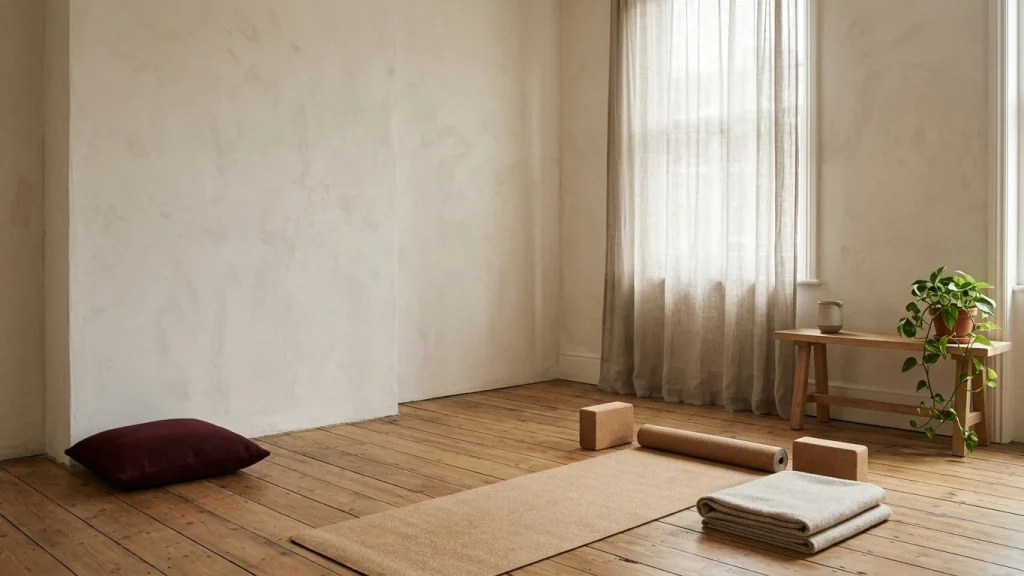
A home yoga room asks for less square footage and more specific things than people expect. It does not need a mirror, it does not need much furniture, and it does not need to be large. It does need a floor with the right amount of grip, one clear wall, and a ceiling you are not staring into a bare bulb from.
Most of the advice on this subject is decoration. This is the practical version: the dimensions, the surfaces, and the four decisions that determine whether you use the room daily or twice a month.
How Much Space a Yoga Practice Actually Needs
Start with the mat and work outward.
A standard mat is 24 by 68 inches. Long mats run 26 by 72 or 26 by 84. Around that you need room to extend your arms in every direction and to step wide without hitting anything.
| Use | Clear floor area | Comfortable |
|---|---|---|
| One person, mostly seated and standing | 6 × 8 ft | 7 × 9 ft |
| One person, full vinyasa with wide poses | 7 × 9 ft | 8 × 10 ft |
| Two people side by side | 10 × 10 ft | 12 × 12 ft |
| Practice including inversions | Add wall access | 8 × 10 ft plus clear wall |
Ceiling height is the constraint people forget. Standing with your arms overhead already needs about seven feet for most adults. Headstands, handstands and shoulder stands need more, and a basement at 6’10” rules out half a practice permanently. Measure before you commit to a room, not after you have laid the floor.
The floor area does not need to be a dedicated room, incidentally. It needs to be clear — a 7 by 9 foot rectangle you can uncover in under a minute. That is a lower bar than a spare bedroom and a higher bar than a corner of the living room with a coffee table in it.
Choosing the Room
Rank candidates by ceiling height first, then floor surface, then light.
Spare bedroom is the default and usually the right answer. Correct ceiling height, a door, a window, and a floor that is either already suitable or easy to change.
A dining room nobody uses works well and is often larger. The problem is that it is usually open to other rooms, so you will want a curtain, a screen, or the acceptance that people walk through.
Basement is quiet and private and frequently disqualified by ceiling height. Check before anything else. If it clears seven and a half feet, it can be excellent.
Attic or bonus room has the opposite problem: plenty of height in the middle, none at the edges. Usable if the clear zone under the ridge is wide enough.
Garage bay gives you area and needs insulation, heat and a floor. Better suited to a general gym than to yoga, unless you finish it properly.
Living room corner is where most practices actually happen. Make it work by keeping the required rectangle permanently clear and storing the mat somewhere you pass daily.
The Floor: The One Decision That Matters Most
Everything about a yoga room comes back to what is under the mat.
Hardwood is the standard for a reason. Firm, level, slightly warm, and it gives a mat something to grip. Standing balances are noticeably steadier on a hard surface than on anything soft.
Cork is the best specialist choice. Slight cushion underfoot, warm, quiet, naturally antimicrobial, and it has grip of its own. It is comfortable to sit on directly without a mat, which changes how much you use the room. Around $3 to $8 per square foot.
Bamboo and engineered wood behave like hardwood and cost less. Fine.
Low-pile wool rug over a hard floor is the cheapest good solution. Buy flatweave, not shag — pile height is what causes the instability.
What does not work: thick carpet, because a mat slides on it and balance poses become guesswork. Tile and concrete, because they are cold, unforgiving on knees, and slippery under a sweaty mat. Thick foam puzzle tiles, which feel luxurious for two minutes and then make every standing pose wobble.
The level of the floor matters more than you would think. An old house with a floor sloping half an inch across the mat will make one side of every asymmetric pose feel wrong, and you will spend months assuming it is your hips.
Wall Space Is a Feature, Not Leftover
Reserve one clear wall. This is the instruction most home yoga rooms miss.
A wall gives you legs-up-the-wall, supported inversions, handstand practice, standing alignment checks, and a place to rest a bolster. It needs to be genuinely clear — no baseboard heater, no radiator, no window ledge at hip height, no artwork you would be kicking.
Six feet of clear width and full height is the target. Bare paint or plaster is ideal; textured wall coverings scuff.
If you are renovating anyway, a yoga wall with mounted rope anchors is a serious upgrade and needs to go into studs or blocking. Retrofitting one into drywall alone is not adequate for body weight.
The opposite wall is where storage and the screen go, so plan them as a pair.
Light for Morning and Evening Practice
The distinguishing feature of a yoga room is how much time you spend lying down looking upward.
Never put a bare fixture in the middle of the ceiling. You will be flat on your back staring into it during savasana, which is the exact moment the room is supposed to disappear. Use a diffused flush fixture, a paper shade, wall sconces, or lamps only.
Natural light on the east side is worth choosing for if you practice in the morning. Direct sun on a mat is unpleasant by about the third pose, so plan on a sheer or linen layer to diffuse it.
Dimmable, warm, and low. 2700K, on a dimmer, with at least one source at floor level. Evening practice under bright overhead light does not settle.
Avoid anything that flickers. Cheap LED dimming is visible when you are still and looking up. Buy fixtures and dimmers rated to work together.
Temperature, Air and Hot Yoga at Home
Normal practice wants the room two to four degrees warmer than the rest of the house — around 72 to 75°F. You start cool and still, and you finish lying motionless for ten minutes, which is when people get cold and cut savasana short.
Air movement should be minimal during practice and generous afterward. Crack a window when you finish rather than running a fan on you while you work.
Hot yoga at home is a genuine project, not a thermostat setting. The target is roughly 95 to 105°F at around 40 percent humidity. That means:
- A dedicated heater sized for the room, usually infrared panels or a ducted supply
- A humidifier with real capacity, not a desktop unit
- Finishes that tolerate repeated humidity cycling — moisture-resistant drywall, a proper vapor strategy, sealed floors
- Ventilation to dry the room afterward, ideally an exhaust fan
Skipping the last two is how people end up with mold behind the drywall within a year. If hot practice is the plan, treat the room like a bathroom, not like a bedroom.
Props, and Where They Live
The prop list is short and it does not change much:
- Mat, plus a second thin travel mat if you practice on hard floor
- Two blocks, cork rather than foam — foam compresses under load and cork does not
- A strap
- A bolster, the single most underused prop in home practice
- Two folded blankets, wool or cotton
- A wheel, if that is your practice
That fits in one basket or on one shelf. Which is the point: storage should hold everything and close. A lidded basket, a low cabinet, or a wall-mounted rack with the mat rolled vertically.
Store the mat where you will see it, not in a closet. The friction between intention and practice is almost entirely about whether the mat is already out.
Sound: Music, Video, and the Neighbors Below
Three separate problems.
A screen for classes needs to be visible from the floor, which is not where televisions are usually mounted. Sitting cross-legged, your eye line is around 36 to 40 inches. A wall-mounted screen at standard viewing height is useless for anything except standing sequences. Mount low, or use a tablet on a floor stand.
Speakers should be behind or beside you, not aimed at the mat. One decent bluetooth speaker on a shelf is plenty.
Impact noise travels down. In an apartment or over a finished room, jumping transitions and dropping into chaturanga carry. A rug with a felt underlay under the practice area helps considerably. So does moving jumping transitions out of your sequence, which is a smaller sacrifice than it sounds.
Soft surfaces stop the room ringing. A curtain, a rug and one upholstered piece will do more than acoustic panels in a room this size.
What to Leave Out
A mirror. This is the main difference between a yoga room and a pilates or general workout room. Most yoga traditions treat practice as internally directed, and a mirror pulls attention outward. If you want one for alignment checks, make it a single leaning full-length mirror you can turn to the wall, not a fixed mirror wall.
Strong scent during practice. Fine before and after; distracting when you are breathing deliberately. Air the room instead.
A television at normal height. See above.
Furniture. A yoga room with a chair in it becomes a room with a chair in it.
Anything from another room. The laundry basket, the exercise bike, the box of things going to storage. A yoga room dies the same way every spare room dies.
Common Questions
How much space do you need for a home yoga room? A clear rectangle of about 7 by 9 feet suits one person doing a full practice, and 6 by 8 is workable. Ceiling height matters as much as floor area — allow at least seven and a half feet if you plan to do any inversions.
What is the best flooring for a yoga room? Hardwood or cork. Both are firm enough for stable standing balances and warm enough to sit on. Avoid thick carpet, which makes a mat slide and destabilizes balance poses, and avoid tile or bare concrete.
Do I need a mirror in a yoga room? No, and most practitioners prefer not to have one. Mirrors suit pilates, weight training and dance, where visual alignment feedback is part of the method. For yoga, a single movable full-length mirror is the most anyone needs.
Can I put a yoga room in the basement? Yes, if the ceiling clears about seven and a half feet and you address the light and the damp. Basements are quiet and private, which are two of the three things a yoga room needs.
How do I set up hot yoga at home? You need a dedicated heater capable of reaching 95 to 105°F, a humidifier with real capacity, moisture-tolerant wall finishes and an exhaust fan to dry the room afterward. Treat the room as a wet space, or expect moisture damage within a year.
What is the difference between a yoga room and a wellness room? A wellness room is a quiet space for sitting, breathing or reading, and needs almost no floor area. A yoga room is a movement space with specific requirements for clear floor, ceiling height, wall access and surface grip. Many rooms serve both, but the yoga requirements are the ones that constrain the design.