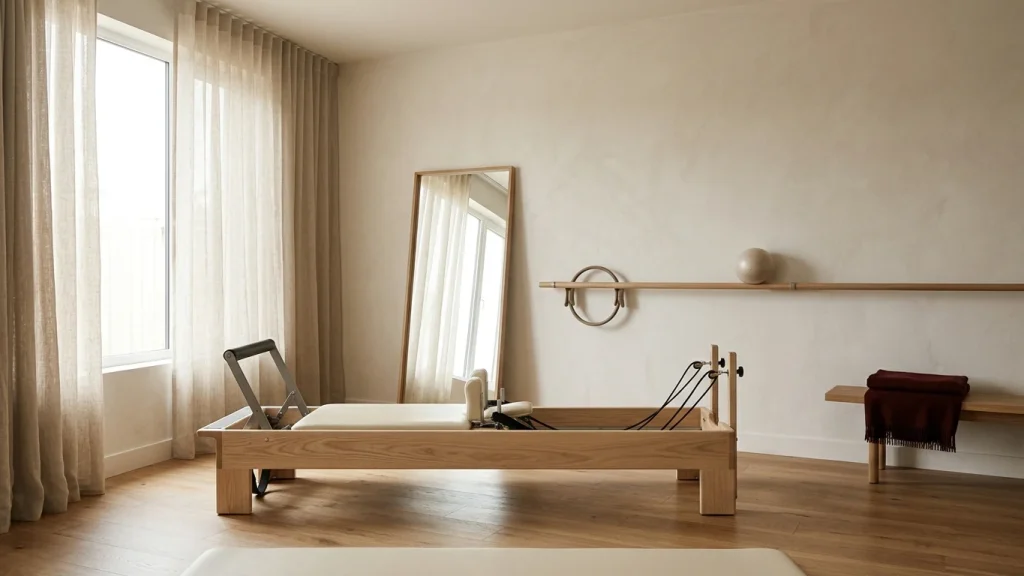
A reformer is roughly eight feet long. That number decides most of what follows, and it is the number people discover after ordering.
Everything else about a home pilates room is manageable — the floor, the light, the storage. The space planning is the part that has to be right first, because a reformer wedged into a room without clearance is a reformer you cannot safely get on and off.
What Reformer Pilates at Home Actually Requires
Four things, in order of how hard they are to change.
Length. A studio reformer runs 86 to 98 inches long. Add clearance at both ends and you need a wall-to-wall dimension of at least eleven feet.
Clearance on one long side. You mount and dismount from the side, and you use the standing work from beside the machine. Two and a half to three feet.
A level floor. More important than the surface. A reformer on an uneven floor rocks under load, which is both unpleasant and unsafe.
Ceiling height, if you want a tower. Eight feet for standing work, more for a tower or half-trapeze.
Everything after that is comfort.
The Reformer: Sizes, Types and What They Cost
| Type | Length | Price | Notes |
|---|---|---|---|
| Studio reformer | 96–98 in | $3,000–7,000 | Full spring range, commercial build, does not fold |
| Home reformer | 86–96 in | $1,500–3,500 | Lighter frame, often folds or has wheels |
| Folding reformer | 86–94 in | $1,200–3,000 | Stores upright or under a bed |
| Budget reformer | 76–86 in | $400–1,200 | Shorter track, lighter springs, limited progression |
| Reformer with tower | 96–98 in | $4,000–9,000 | Adds vertical work, needs ceiling height |
| Cadillac / trapeze table | 89–98 in | $5,000–12,000 | Studio equipment. Very large, very heavy |
Two things worth knowing before you shop.
Budget reformers shorten the track, which changes the exercises rather than just the price. If you are used to a studio machine, a short-track reformer will feel wrong in footwork and long spine. Check the carriage travel, not just the overall length.
Spring systems are not interchangeable. Different manufacturers use different spring tensions and different color codes, so a class or video that says “one red and one blue” may mean something different on your machine. Learn what your springs actually do rather than following colors.
How Much Room You Need Around It
Measured from the machine, not from the wall.
| Position | Clearance | Why |
|---|---|---|
| Foot end (footbar) | 2–3 ft | Standing lunges, footbar work, adjusting |
| One long side | 2.5–3 ft | Mounting and dismounting, standing side work |
| Other long side | 1–1.5 ft | Enough to reach and clean |
| Head end | 1.5–2 ft | Straps, headrest, reaching past |
Practical room sizes: 11 by 8 feet is the workable minimum for a reformer alone. 12 by 10 feet is comfortable and leaves space for mat work beside the machine. A reformer plus a mat area plus storage wants around 12 by 12.
That is a spare bedroom in most American houses, which is good news — this does not require a dedicated studio.
Do not put the reformer against a wall on both long sides. It will fit, and you will not want to use it.
Ceiling Height and the Tower Question
Standard ceilings at 8 feet handle a reformer and mat work without any issue.
A tower or half-trapeze changes that. The vertical frame is typically 6 to 7 feet tall on its own, mounted at the head end of the reformer. That fits under 8 feet, but the exercises performed with arms extended overhead while standing on the machine do not. Plan on 8.5 to 9 feet if a tower is part of the intention.
Jumpboard work is fine under 8 feet — you are lying down.
Standing work on the carriage — standing footwork, side splits — puts your head at your own height plus the carriage height of roughly 14 inches. Anyone over 5’8″ should measure this rather than assume.
And the storage trap: a folding reformer stood on end needs a ceiling higher than the machine is long. An 8-foot reformer will not stand upright under an 8-foot ceiling. Check before buying a machine specifically for its vertical storage.
Mat Pilates Without a Machine
Worth saying plainly: mat pilates is the original method, and a serious mat practice needs almost nothing.
- A firm mat, thicker than a yoga mat — around 8 to 15 mm, because there is a lot of rolling on the spine
- A magic circle
- A small soft ball
- A long resistance band and a short loop
- A foam roller
- Light hand weights, 1 to 3 pounds
That is under $200 and it fits in a basket. The space requirement is a clear 7 by 9 feet, the same as a yoga room.
If you are unsure whether a reformer belongs in your house, do six months of mat work first. It answers the question honestly and it costs almost nothing.
The Floor
Level matters more than material. Check with a long level in both directions before deciding where the machine goes. Older houses commonly have half an inch of fall across a room, and a reformer on that will move under you.
Hard floors beat carpet. A reformer on carpet sinks slightly, the frame flexes, and the feet can shift during vigorous work. If the room is carpeted, put a hard board or a firm mat under the full footprint.
Good surfaces: cork, engineered wood, vinyl plank, hardwood. All are warm enough for mat work and firm enough for the machine.
Protect underneath the machine. A thin dense mat under the reformer feet stops indentation in wood and vinyl, and it dampens the carriage sound, which is louder than people expect in a quiet house.
Rubber gym flooring is unnecessary unless you are also lifting in the room. It is darker, smells, and offers nothing pilates needs.
Mirrors, Light and the Room Itself
Unlike yoga, pilates genuinely benefits from a mirror. The method is precise about alignment, and seeing yourself is how you correct a rotated pelvis or an uneven shoulder without a teacher in the room.
Put it along the long side of the reformer, not at the end. The useful view is from the side — you need to see the line of your spine, not your face.
Six to eight feet of mirror at standing height is sufficient. A single leaning full-length mirror positioned beside the machine works well and avoids mounting.
Lighting: you spend most of a reformer session on your back. No bare fixture in the middle of the ceiling. Wall lights, a floor lamp, or a diffused flush fitting, all on a dimmer, around 2700 to 3000K.
Natural light on the long side is ideal, and a window you can open matters, because the room warms up faster than you expect.
Sound carries through the frame. The carriage running on its track, and the springs releasing, are audible below. A dense mat under the machine and a rug in the room take most of it out.
Storage and Folding Options
Folding reformers either fold in half or stand upright. Check the folded dimensions and the ceiling clearance before choosing this as your storage plan.
Wheels are more useful than folding in most rooms. A reformer on castors can be pulled away from the wall for a session and pushed back afterward, which is enough for a room that has another purpose.
Vertical wall storage for props — a simple rail with hooks for bands, the magic circle and the loop. Keeps a small room from looking like a clinic.
A closed cabinet or bench for the ball, roller, weights and a towel.
Cover the machine if the room gets sun. Upholstery fades and the vinyl hardens.
Learning at Home Without a Teacher
The honest caveat in an article about building the room.
Reformer work involves spring loads acting on your spine and joints in positions you cannot see yourself in. It is not dangerous when done correctly, and it is genuinely possible to hurt yourself repeating a movement wrong for months.
Take instruction first. A block of studio classes, or a series of private sessions, before or alongside setting up at home. Learning the spring settings and the fundamental positions with someone watching is worth considerably more than any equipment upgrade.
Then use structured programming at home — a subscription platform with a proper curriculum rather than assorted videos.
Have your setup checked periodically, even once a year. Small alignment habits accumulate.
If you have a disc issue, osteoporosis, or you are pregnant or postpartum, get individual guidance. Several standard mat and reformer exercises are contraindicated in each of those cases, and general classes will not flag them for you.
Common Questions
How much space do you need for a reformer at home? A room of at least 11 by 8 feet for the machine alone, and 12 by 10 to also have space for mat work. The reformer itself is 86 to 98 inches long and needs two to three feet of clearance at the foot end and on one long side.
What ceiling height do you need for reformer pilates? Eight feet is enough for the reformer and mat work. A tower or half-trapeze, and standing work performed on the carriage, want 8.5 to 9 feet. A folding reformer stored upright needs a ceiling taller than the machine is long.
Is a home reformer worth it? If you already practice regularly and have the space, it pays back against studio class prices within one to two years. If you have never used one, take studio classes first — the machine is a significant purchase and the method takes instruction to learn safely.
Can you do pilates on carpet? Mat pilates, yes, though a firm surface is better for rolling work. A reformer on carpet is a problem — the frame sinks and can shift under load. Put a hard board or firm mat under the full footprint if the room is carpeted.
Do I need a mirror for pilates? It is genuinely useful, unlike in yoga. Place it along the long side of the reformer so you can see your spine in profile. Six to eight feet is plenty, and a leaning mirror works.
What is the difference between a studio and a home reformer? Studio machines have heavier frames, full spring ranges and longer carriage travel, and they do not fold. Home models are lighter and often fold or roll, sometimes with a shorter track that changes how the exercises feel.