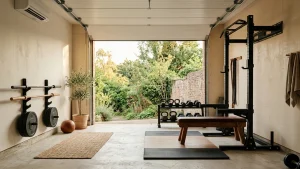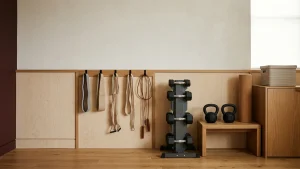
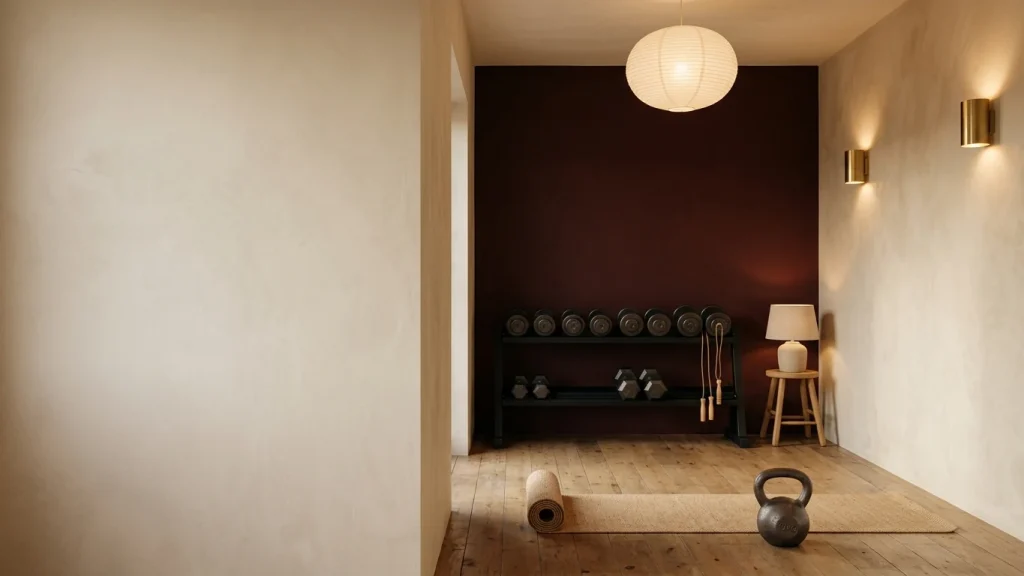
The difference between a room you look forward to and one you avoid is mostly light. Equipment is equipment. But a room lit by one cold fixture in the middle of the ceiling, with white walls and a black floor, feels like a place you go to complete a task.
This is the technical side: how much light, what color, where to put it, and which paint and wall treatments hold up in a room that gets sweated in.
Why Gym Lighting Is Usually Wrong
Four faults, and almost every home gym has at least three.
One source, in the middle of the ceiling. Everything is lit from directly above, which puts shadows in your eye sockets and under your jaw. In front of a mirror it is genuinely demoralizing.
Too cool. 5000K daylight bulbs, chosen because they seem energetic. They read as clinical, and they make skin look grey.
Low CRI. Cheap fixtures render color badly. Wood looks flat, skin looks unwell, and the whole room looks cheaper than it is.
No dimmer. A room that is one brightness is a room with one mood. Lifting and stretching want different light.
The Numbers: Lumens, Kelvin, CRI
| Specification | Target | Notes |
|---|---|---|
| Light level | 300–500 lux (30–50 foot-candles) | Roughly 20–35 lumens per square foot |
| Total output, 12 × 12 ft room | 3,000–5,000 lumens | Split across three or four fixtures |
| Color temperature | 3000K | 2700K for a yoga or pilates room; 4000K is the upper limit |
| CRI | 90+ | Below 90 everything looks flat, especially in a windowless room |
| Dimming | On every circuit | Buy dimmers rated for the fixtures you chose |
3000K is the right compromise for a mixed gym. It is warmer than any commercial gym and cool enough that you feel awake. If the room is used mainly for yoga, pilates or mobility, drop to 2700K.
Spread the output. Four 1,000-lumen fixtures produce a far better room than one 4,000-lumen fixture, because even coverage is what removes shadows and the cave effect.
Check the flicker. Cheap LED dimming is visible when you are lying still and looking up. Buy the fixture and the dimmer as a matched pair, or expect to replace one of them.
Layering: Three Circuits, One Room
Three switches, three purposes.
Ambient. Ceiling fixtures, spread evenly, dimmable. This is your working light for training.
Task. Brighter and directional at the lifting zone or the mirror. A pair of wall lights, or a track with the heads aimed at the equipment rather than at you.
Accent. One low, warm source — a floor lamp, an uplight in a corner, a light behind a slat wall. Used alone for stretching, mobility and cool-down, and it is what makes the room usable at 9 p.m. rather than only at 7 a.m.
If you install nothing else, install the third one. A gym you can be in with the main lights off is a gym you spend more time in.
Which fixtures to use for each layer:
| Layer | Fixture | Notes |
|---|---|---|
| Ambient | Diffused flush mounts, or recessed cans with a frosted trim | Four to six across the ceiling, never one in the center |
| Ambient, low ceiling | Slim LED panels or surface-mount discs | Under 7’6″ anything pendant is a hazard |
| Task | Track heads aimed at the equipment, or a pair of sconces | Aim at the wall or the rack, never at eye level |
| Accent | Floor lamp, corner uplight, LED strip behind a slat wall | Warm, low, and always on its own switch |
| Retrofit, no rewiring | Plug-in sconces, a smart bulb in the existing fixture, one good floor lamp | Gets you most of the effect for under $200 |
If you can only run one new circuit, run the accent one. The ambient light in most rooms is already adequate and merely unflattering; what is missing is a low warm source, and that is also the cheapest to add.
Put the switches by the door and make them obvious. Three unlabeled switches in a row means everyone uses the first one forever, which defeats the entire scheme. Separate them, or use a smart switch with named scenes — bright for lifting, low for stretching.
Smart bulbs are worth it here more than in most rooms, because the two lighting states a gym needs are genuinely different and switching between them by hand at the end of a session rarely happens.
Lighting for Mirrors
The same rules as a bathroom, for the same reasons.
Never a downlight directly above the mirror. Light from straight overhead produces the least flattering face in interior design, and it is the default in most gyms.
Light from the sides. Sconces flanking the mirror at roughly face height, 60 to 66 inches to center, is the flattering arrangement.
Or light from behind the viewer, bounced off the opposite wall. Softer and easier to retrofit.
Check the reflection before you fix anything. Stand where you will actually stand, hold a lamp where the fixture would go, and look. A bright source visible in the mirror is distracting through every set.
The mirror will roughly double the apparent light in the room, so plan on needing less total output than you first calculated.
Lighting for Floor Work
If anyone does mat work in the room, the ceiling is a surface you will be staring at.
No bare bulbs, no exposed LED strips, no open shades pointing down. A diffused flush-mount fitting, a fabric or opal shade, or wall lights only.
Wall washers and cove lighting are the best solution — light thrown at the walls and ceiling, with nothing visible from below.
One low corner source for savasana, the end of a stretch session, or the ten minutes after a workout when the room stops being a gym.
Paint Colors That Work
Warm neutrals, with one grounding tone if the room can take it.
The reliable range: bone, oat, greige, mushroom, warm clay, soft taupe. Anything with a yellow, red or brown base rather than a blue one.
One grounding wall in charcoal, deep olive, or a deep oxblood behind the rack. It anchors the room, it makes the equipment recede, and it hides marks where hands and bars touch the wall.
What to avoid:
- Bright white. Combined with a dark floor, it is the institutional combination. It also goes grey under artificial light.
- Cool grey. Reads dead in a room without daylight, which is most gyms.
- Saturated red, orange or lime. The commercial-gym palette. It dates fast and it is exhausting to be in.
- Navy in a windowless room. It works beautifully with daylight and swallows a basement.
Light walls in a dark room, darker walls in a bright one. A windowless basement wants pale walls to bounce what light there is. A garage bay with the door open in summer can carry something much deeper.
Paint the ceiling. White is fine in a normal room. In a basement with exposed joists, one dark color across everything overhead makes the ceiling disappear and reads as deliberate.
Sheen, and Why It Matters in a Gym
This gets overlooked and it determines whether the paint survives.
Flat and matte hold marks and cannot be scrubbed. In a room where hands, bars, chalk and sweat touch the walls, ordinary flat paint will look poor within a year.
Eggshell or satin is the right choice. Washable, slight sheen, still soft enough to look domestic.
Scrubbable matte — the newer washable matte formulations — is the best of both if you want a flat look. More expensive, worth it.
Semi-gloss and gloss are too reflective for whole walls, and the shine reads commercial. Fine on trim.
Bathroom or kitchen paint with mildew resistance is a sensible specification for a gym, particularly a basement or garage. It handles humidity better than standard wall paint.
Wall Treatments Beyond Paint
Plywood, full or half height. Birch or maple ply, sealed or painted. You can mount anything anywhere without hunting for studs, it survives impacts, and it looks considerably better than drywall with holes in it. This is the single most practical wall treatment for a gym.
Slatted wood. Vertical timber slats over an acoustic backing. Absorbs sound, adds warmth, hides mounting points, and it is the treatment that most reliably makes a gym look designed.
Rubber wall guard behind the rack, at bar height. Practical, prevents dents, and a matte black band at that height reads as intentional rather than industrial.
A pegboard or slat panel for bands, straps and small equipment. Functional storage that also fills a wall.
Limewash or mineral paint for texture, which is the cheapest way to stop a room looking flat.
One large piece of art or a large mirror. A single large object beats a gallery of small ones in a room with equipment in it.
Skip the vinyl lettering and motivational decals. They date immediately and they belong to a commercial vocabulary.
Windows, Daylight and Window Coverings
A gym with a window gets used more than one without. If you have a choice of rooms, this should weigh heavily.
Do not put the mirror opposite a window. You end up backlit and unable to see anything useful, and the glare is unpleasant.
Do not put a screen opposite a window either, for the same reason.
Sheer linen or a light-filtering roller rather than a blackout blind. Diffused daylight is the best light the room will ever have.
Blackout only if you project video or the room doubles as a guest room.
Think about night-time privacy. A brightly lit ground-floor room with large windows is a stage after dark. A blind you actually close, or a lower-level lighting scheme in the evening.
Common Questions
What color temperature should home gym lighting be? 3000K for a mixed gym — warmer than commercial lighting and cool enough to feel alert. Drop to 2700K for a yoga or pilates room. Avoid 5000K, which reads clinical and makes skin look grey.
How many lumens does a home gym need? Roughly 20 to 35 lumens per square foot, which is 3,000 to 5,000 lumens total for a 12 by 12 foot room. Spread that across three or four fixtures rather than concentrating it in one.
What is the best paint color for a home gym? Warm neutrals — bone, oat, greige, mushroom or soft clay — with an optional grounding wall in charcoal, deep olive or oxblood behind the equipment. Avoid bright white with dark flooring, cool grey, and saturated commercial-gym colors.
What paint finish should I use in a home gym? Eggshell, satin, or a scrubbable matte. Ordinary flat paint holds marks and cannot be washed, which fails quickly in a room where hands and equipment touch the walls. Mildew-resistant bathroom paint is a sensible choice for basements and garages.
How should I light a gym mirror? From the sides, with wall lights at about face height, or from behind the viewer bounced off the opposite wall. Never with a downlight directly above the mirror, which casts shadows into the eyes and under the jaw.
What can I put on home gym walls instead of paint? Plywood panelling, which lets you mount equipment anywhere; slatted wood, which adds warmth and absorbs sound; a rubber guard band at bar height behind the rack; or a pegboard for storage. One large mirror or a single large artwork finishes it.