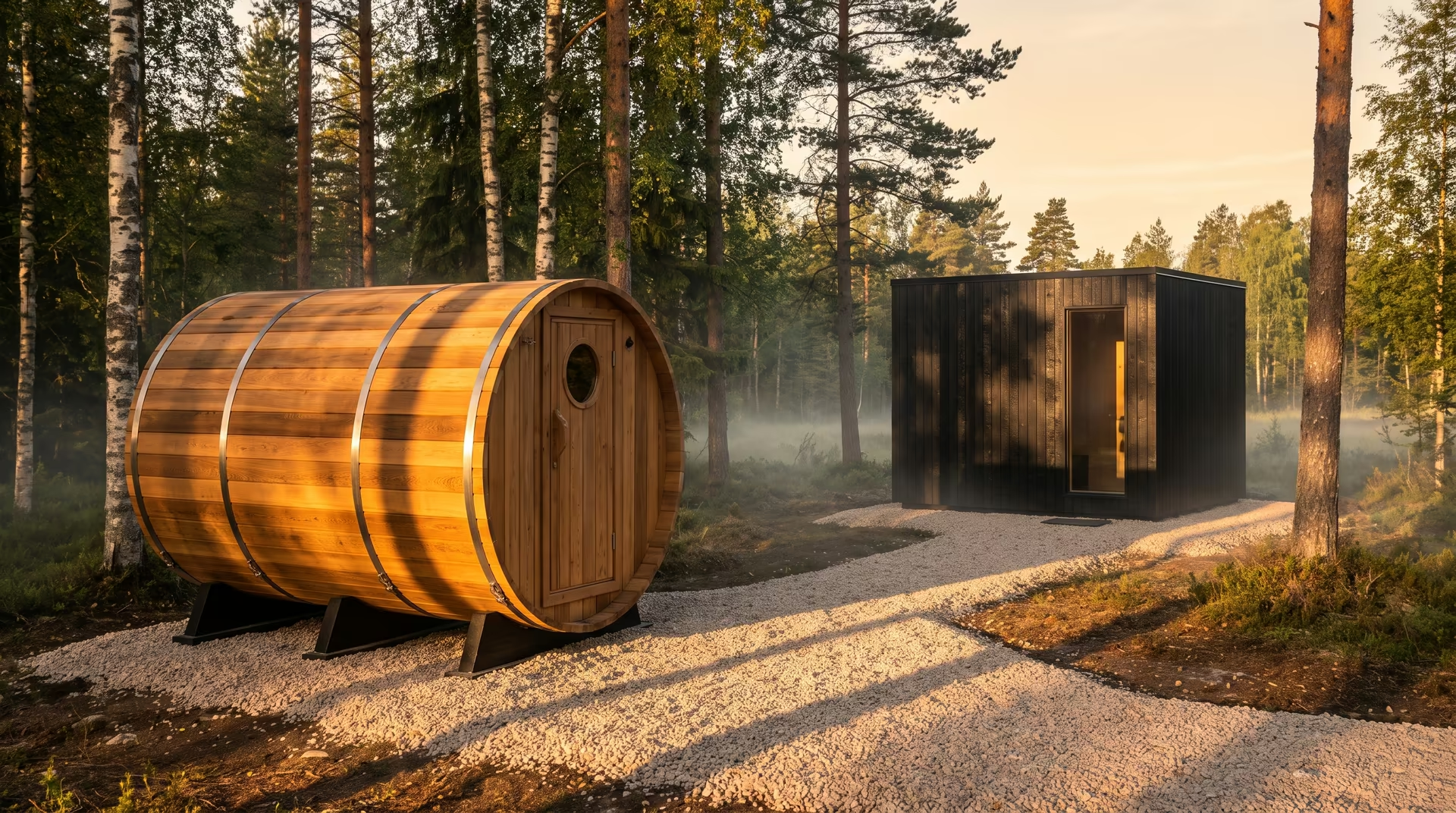
Two shapes dominate the outdoor sauna market, and most of the comparison written about them is about appearance. The differences that matter are how fast each one heats, how the benches work inside, and what happens on your particular site.
Here is the practical version.
The Short Answer
Buy a barrel sauna if your priority is heating quickly and cheaply, you have a garden rather than a modern architectural setting, you want a kit you can assemble yourself over a weekend, and four people is a crowd you rarely exceed.
Buy a cabin sauna if you want two bench heights, you live somewhere genuinely cold, you plan to add a changing area or porch, you want the structure to look deliberate next to a contemporary house, or you expect to use it with six people.
If neither of those settles it, the barrel is the lower-risk purchase. It costs less, it heats faster, and the people who regret buying one usually regret the size rather than the shape.
How a Barrel Sauna Actually Performs
The cylinder is not styling. It is the reason the thing works as well as it does.
Less air to heat. A round cross-section contains meaningfully less volume than a square one of the same width and height. Less volume means faster heat-up and lower running costs. A well-built barrel with an appropriately sized heater reaches temperature in roughly 30 to 45 minutes.
Better air circulation. Hot air rises, curves along the ceiling, and returns down the far wall. The convection loop in a barrel is unusually even, which is why the temperature at head height is consistent from one end to the other.
It sheds water. Rain and snow run off a curved roof without a roof structure. There is nowhere for water to pool, which is a real durability advantage.
Assembly is straightforward. Most barrels ship as pre-cut staves with steel bands. Two people, a weekend, hand tools.
The compromises
Bench layout is constrained. The curve means one comfortable bench height on each side, with the walls sloping away behind your shoulders. Two-tier seating, which is the traditional way to control how hot your session is, does not fit well in most barrels.
Headroom drops at the edges. Standing up near a wall is uncomfortable in anything under six feet in diameter.
The bands need attention. Staves expand and contract with humidity and season. Barrel saunas need their bands re-tightened periodically, particularly in the first year. It is a ten-minute job, and skipping it for three years is not.
Interior storage is nonexistent. No corners, no flat walls, nowhere to build in a shelf that does not intrude.
How a Cabin Sauna Actually Performs
The cube or cabin is what a Finnish sauna traditionally is, and the shape follows from what happens inside.
Two bench tiers work properly. This is the biggest functional advantage and the one people underestimate. The upper bench might sit at 190°F while the lower is at 150°F. Being able to choose is what makes a sauna usable by two people with different tolerances, and what lets you extend a session by moving down rather than leaving.
Better insulation is possible. Flat walls take conventional insulation, a vapor barrier and foil facing. In a genuinely cold climate — Minnesota, Maine, Alberta — an insulated cabin holds temperature in a way a barrel does not.
It expands. A porch, a changing room, a covered bench outside the door. Modular in a way a cylinder is not.
It reads as architecture. Next to a contemporary house, a cube in vertical charred timber or dark-stained cladding looks intentional. A barrel next to the same house looks like an object that arrived on a truck.
The compromises
Slower to heat and more expensive to run. More air volume, more surface area. Expect 45 to 75 minutes to temperature.
It costs more for the same seating capacity, generally 40 to 80 percent more.
The roof is a maintenance item in a way the barrel’s is not. Flashing, shingles or membrane, and a slope that actually sheds.
Assembly is more involved. Many cabin kits are still DIY-friendly, but some require a contractor or a crane for panelized delivery.
Side by Side
| Barrel | Cabin | |
|---|---|---|
| Heat-up time | 30–45 min | 45–75 min |
| Running cost | Lower | Higher |
| Bench tiers | One practical level | Two |
| Cold-climate performance | Adequate | Better |
| Typical price, 4-person | $5,000–12,000 | $8,000–20,000 |
| Assembly | Two people, a weekend | Weekend to contractor job |
| Expandable | Not really | Yes |
| Maintenance | Re-tension bands | Roof, standard building upkeep |
| Suits | Gardens, cabins, traditional settings | Modern houses, cold climates, larger households |
Size: How Many People, Honestly
Manufacturer capacity ratings are optimistic in the way that furniture measurements are optimistic.
| Stated capacity | Actual comfortable use | Typical footprint |
|---|---|---|
| 2 person | One lying down, or two sitting close | 4 ft diameter or 4×5 ft |
| 4 person | Two lying down, or three sitting | 6 ft diameter or 6×6 ft |
| 6 person | Four sitting, two lying | 7–8 ft diameter or 6×8 ft |
| 8 person | Six sitting comfortably | 8 ft × 8 ft and up |
The measurement that actually matters is whether you can lie down. A sauna you can stretch out in is a different experience from one you can only sit in, and nearly everyone who bought the smaller unit mentions it.
Buy one size up from what you calculated. The heater cost difference is modest and the regret is not.
Wood: Cedar, Spruce, Thermowood, Hemlock
Wood choice affects smell, heat behavior, durability and price.
Western red cedar is the premium default. Naturally rot-resistant, dimensionally stable, low thermal conductivity so it does not scorch skin, and it smells like a sauna should. It silvers outdoors if left unfinished. It is also the most expensive.
Nordic spruce is the traditional Finnish choice and it is what most European saunas are built from. Lighter in color, less aromatic, considerably cheaper, and entirely adequate. It wants more attention outdoors than cedar does.
Thermally modified aspen or alder is the correct choice for benches specifically. The heat treatment removes resins and lowers conductivity, so the bench does not burn you at 190°F. Many good saunas pair a cedar or spruce shell with thermowood benches for exactly this reason.
Hemlock is the budget option. Structurally fine, almost no aroma, less rot resistance. Acceptable for an indoor cabin, a compromise outdoors.
Never use resinous pine for benches or anywhere skin contacts. It weeps sap at sauna temperatures.
Heaters: Electric, Wood-Fired, and What Each Demands
Electric
The default for a reason. A 6 to 8 kW heater serves most residential saunas, on a dedicated 240V circuit of 40 to 60 amps, hard-wired by an electrician. Add a timer or a remote start and the sauna is ready when you get home, which materially increases how often it gets used.
Sizing rule: roughly one kilowatt per 45 to 50 cubic feet of interior volume, upward for glass doors and uninsulated walls. Undersizing is the most common and least fixable mistake.
Wood-fired
The better experience and the larger project. No electrical run, which can save thousands on a remote site. A different quality of heat, and the sound and smell that people who grew up with saunas are actually chasing.
What it demands: a chimney with correct clearances to combustibles, a spark arrestor in most jurisdictions, a permit almost everywhere, a notification to your homeowners insurer, and 45 minutes of tending before each session. Also somewhere dry to keep split wood.
If the sauna is more than fifty feet from the house, wood-fired is often the cheaper build once electrical trenching is priced.
What about infrared
Infrared cabins are an indoor product. They rely on radiant energy reaching a body directly and do not perform well in an uninsulated outdoor structure in cold weather. If you want outdoor, you want a traditional heater.
Assembly, Delivery and Site Prep
The part that surprises people is logistics.
Delivery arrives on a pallet by freight truck, typically curbside. A 6-foot barrel kit weighs somewhere between 1,200 and 2,000 pounds across multiple bundles. Confirm you can get it from the curb to the site before ordering — a narrow side gate is a genuine problem.
The pad has to be level and it has to drain. Options in ascending order of permanence: compacted gravel, concrete pavers on gravel, concrete slab, or a pressure-treated frame on deck blocks. Barrels sit on cradles and need only the cradle points supported; cabins want continuous bearing.
Leave air underneath. Direct contact between a wooden structure and soil is how sauna floors rot. Four to six inches of clearance, or a gravel bed that drains freely.
Assembly time for a typical barrel kit is one to two days with two people and basic tools. Cabin kits vary from similar to genuinely requiring a contractor.
Electrical comes after placement, and the electrician will want the structure in position before running conduit. Sequence it that way or you will pay for two visits.
Which One Fits Your Property
A few situations where the answer is clear.
Small urban yard, want it used often: barrel. Faster heat-up matters most when the sessions are spontaneous.
Cold climate, long winters: insulated cabin. The temperature stability is worth the running cost.
Contemporary house, visible from the main rooms: cabin, dark cladding. The barrel is a strong visual statement and it belongs in a garden, not on a terrace.
Remote corner of a rural property: wood-fired, either shape. The electrical run is what decides it.
Renting, or unsure about staying: barrel. It can be disassembled and moved, which a built cabin cannot.
Household of five or more: cabin. Two bench tiers stop being a luxury once more than three people use it at once.
Common Questions
Is a barrel sauna better than a cabin sauna?
Neither is better in general. A barrel heats faster and costs less; a cabin gives you two bench heights, better cold-climate performance and room to expand. Match the shape to your climate, your household size and your site.
How long does a barrel sauna take to heat up?
Typically 30 to 45 minutes with a correctly sized electric heater, and 45 to 60 for a wood stove. A cabin takes longer because there is more air and more surface to warm.
Do outdoor saunas need to be insulated?
Barrel saunas generally are not, relying on the thickness of the staves. Cabin saunas usually are, with mineral wool and a foil vapor barrier. In cold climates insulation makes a substantial difference to both comfort and running cost.
What is the best wood for an outdoor sauna?
Western red cedar for the shell if the budget allows, Nordic spruce as a good cheaper alternative, and thermally modified aspen or alder for the benches regardless of what the walls are made of.
Can I assemble an outdoor sauna myself?
Most barrel kits, yes — two people and a weekend. The electrical work should be done by a licensed electrician, and a wood-fired chimney installation is worth having done professionally for insurance reasons alone.
How long do outdoor saunas last?
A well-sited cedar sauna on a properly drained pad, with the bands maintained and the interior allowed to dry between uses, will run twenty years or more. Sitting on wet ground or in permanent shade is what shortens that dramatically.
Keep Reading
- How Much a Home Sauna Really Costs — The full installed cost of each option.
- Sauna and Cold Plunge: How to Set Up Both at Home — Siting, electrical, drainage and the cold side.
- Sauna Benefits: What the Research Actually Shows — What the research supports, and what it does not.