Of all the rooms Japandi gets applied to, the bathroom is where it makes the most sense — and small bathrooms suit it better than large ones.
The reason is structural. Japandi is built on a very short material list, a narrow palette, and the removal of almost everything else. A small room is naturally short on material and light on objects. Applied to a generous primary bath, the same approach can drift toward empty. Applied to a five by eight foot bathroom, it reads as intentional.
Here is what the style actually consists of, what to buy, and the three mistakes that turn it into a beige hotel bathroom.
What Japandi Actually Means
Two traditions that turned out to have the same instincts.
From Japan: wabi-sabi, the acceptance of imperfection and age; a preference for natural materials left close to their raw state; and the practice of leaving space empty on purpose. Objects are few and chosen slowly.
From Scandinavia: functionalism, warmth as a defense against long dark winters, and the mid-century conviction that everyday things should be well made and unornamented.
Where they meet is a room that is spare but not cold, natural but not rustic, and quiet without being severe. The Scandinavian half supplies the warmth that keeps Japanese minimalism from reading as austere. The Japanese half supplies the discipline that keeps Scandinavian design from drifting into cozy clutter.
That balance is the whole style. Lose either side and it stops working.
Why It Works So Well in Bathrooms
Three reasons, and they are practical rather than aesthetic.
Bathrooms are already minimal by function. There are only so many things a bathroom needs. A style that rewards emptiness has less to fight against here than in a living room.
The material list is moisture-appropriate. Stone, sealed wood, plaster, ceramic and linen all belong in wet rooms. Japandi does not ask you to use anything a bathroom cannot support.
Small rooms benefit most from a single material family. Visual breaks make a room read smaller. A bathroom finished in two or three materials rather than seven feels considerably larger than its floor plan suggests, and that restraint is exactly what the style requires anyway.
The Japandi Color Palette
Warm neutrals, one grounding dark, and no more than that.
| Role | Colors | Where it goes |
|---|---|---|
| Base | Warm off-white, oat, bone, plaster white | Walls, large tile, ceiling |
| Mid | Greige, mushroom, pale clay, oak tone | Vanity, floor, wood elements |
| Grounding | Charcoal, soft black, deep umber | Fixtures, frames, one small surface |
| Accent | Muted terracotta, sage, ink blue | One item only — a towel, a bowl, a plant pot |
The single most important instruction: stay warm. The most common failure in this style is reaching for cool grey. Cool grey looks correct on a screen and clinical in a real bathroom, especially under artificial light. Every neutral you choose should have a yellow, red, or brown base rather than a blue one.
Test paint on the actual wall and look at it after dark under the lighting you will really use. A color that reads warm at noon can go grey and lifeless at nine in the evening.
Materials: The Short List
Choose three. Four at most. The discipline is the design.
Light wood — white oak, ash, or Japanese hinoki cypress. Oak is the practical default and takes moisture well when sealed. Hinoki is the authentic choice, smells extraordinary, and costs accordingly.
Microcement or tadelakt — seamless plaster finishes for walls and shower surrounds. This is the material that does the most to make a small bathroom feel larger, because it eliminates grout lines entirely. Tadelakt is the traditional Moroccan lime version and is genuinely waterproof when properly applied; microcement is the modern equivalent and easier to source in the United States.
Stone — honed rather than polished. Limestone, travertine, soapstone, or a warm-toned quartzite. Matte finishes only; gloss is a different style.
Unglazed or matte ceramic — for sinks, soap dishes, and small vessels. The handmade variation is a feature, not a defect.
Linen and unbleached cotton — waffle weave towels, a linen shower curtain if you use one, a simple robe on a wooden hook.
What is not on the list: high-gloss anything, chrome, printed patterns, marble with dramatic veining, or more than one wood tone.
The Fixtures That Fit, and the Ones That Break It
Fixtures are where most Japandi bathrooms are won or lost, because they are the elements people replace last and notice most.
What works
- Matte black or brushed brass hardware. Living-finish brass that darkens over time is the more interesting choice and fits the wabi-sabi half of the equation.
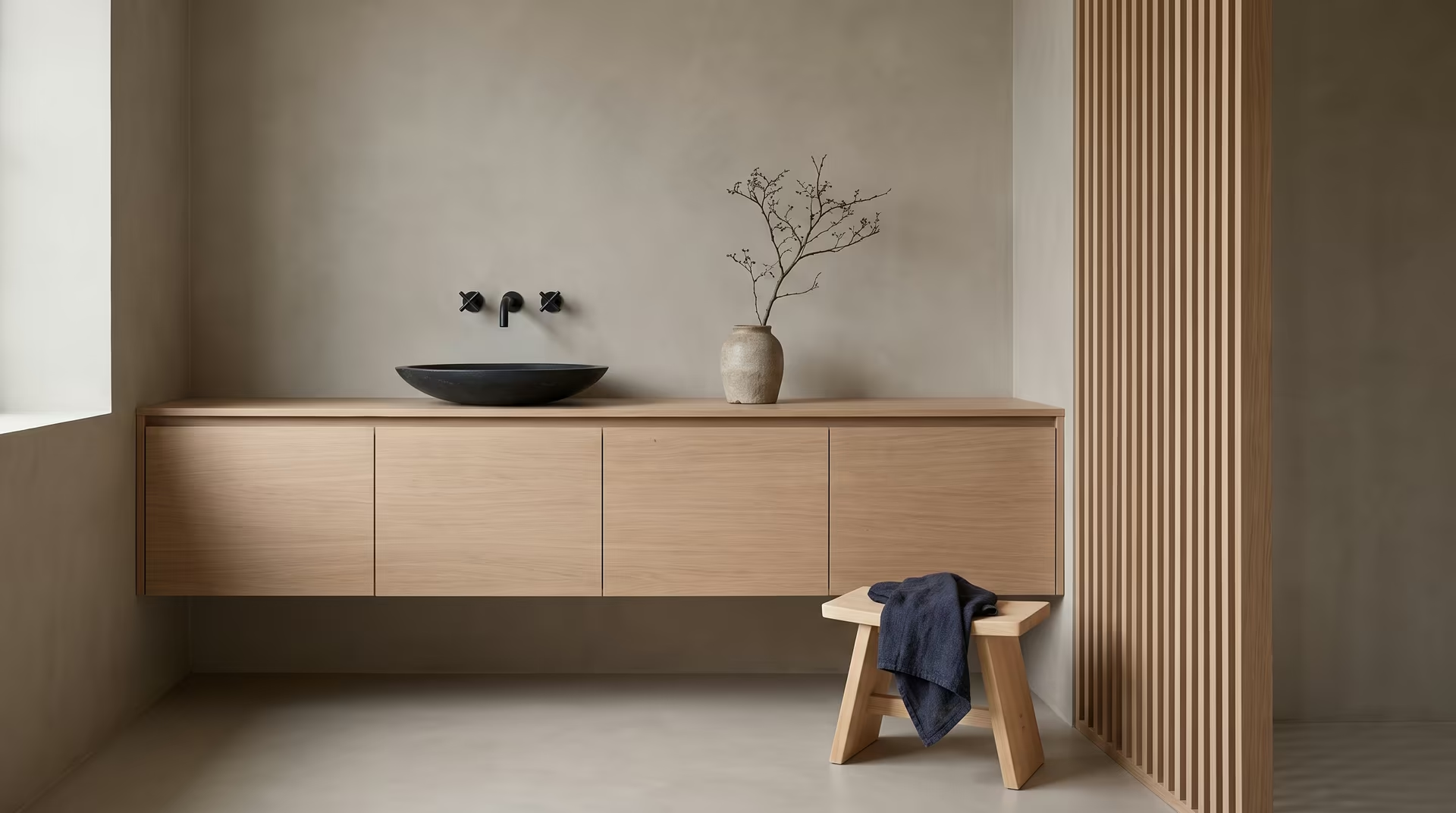
- Wall-mounted faucets over the sink. They clear the counter, which is the entire point, and they look deliberate.
- A vessel or shallow trough sink on a wooden vanity. Undermount works too; pedestal sinks generally do not.
- A floating vanity in oak with flat, handle-free fronts or a simple recessed pull.
- A curbless walk-in shower with a linear drain and clear glass, or no glass at all in a wet room.
- A wall-hung toilet if the plumbing allows. It clears floor area and simplifies cleaning.
What breaks it
Polished chrome. Ornate or traditional fixture profiles. Glass shower doors with heavy black grid framing, which belong to a different look entirely. Multiple metal finishes in one room. Vanity hardware in a contrasting color. Anything with a visible brand mark.
Storage Is the Whole Game
A Japandi bathroom with objects on the counter is not a Japandi bathroom. The style depends on emptiness, and emptiness depends entirely on having somewhere to put things.
Everything closed. Drawers rather than open shelves, cabinet doors rather than baskets on display. If you use open shelving, treat each shelf as a composition with three objects on it and no more.
Decant. Shampoo and body wash in matching amber or frosted bottles. This single change does more for the look than any tile choice.
A niche in the shower rather than a hanging caddy, sized during construction to fit two bottles and nothing else.
Vertical slat panels as a wall treatment can conceal a cabinet front entirely, which is how the photographed versions of this style hide their storage. It is also the one decorative element the style permits, and it adds the texture that stops a spare room from looking blank.
Hooks, not towel bars. Simple wooden or matte black hooks at varying heights. A towel on a hook reads as Japanese; a towel folded over a chrome bar reads as a hotel.
Lighting a Japandi Bathroom
The palette collapses under the wrong light. This is not optional.
2700K, CRI 90 or above. Cooler than that and the warm neutrals turn grey, which is exactly the failure this style is prone to.
Diffuse rather than direct. Paper or opal glass shades, a linen-wrapped fixture, or light bounced off a wall. Bare bulbs and exposed downlights are too hard for the material palette.
Layered and dimmable. One low ambient source, one at face height beside the mirror, and if the room allows it, one low accent — a small floor-level light or a candle in a stone holder.
Let daylight in unfiltered where you can. If privacy demands a treatment, use frosted film or an unlined linen shade rather than a blind. Slatted screens in front of a window are period-correct for the style and cast the kind of striped shadow that makes these rooms photograph so well.
Small Bathroom Strategies
Everything here is aimed at reducing the number of visual interruptions rather than at making the room physically larger.
One continuous floor material, running under the vanity and into the shower without a threshold. Interruptions at the floor are what make small rooms read as small.
Large-format tile or seamless plaster. Fewer grout lines, fewer lines, fewer perceived edges. If you tile, go as large as the room can accept and match the grout to the tile.
Float everything. A wall-hung vanity and a wall-hung toilet expose the floor beneath them, and visible floor reads as space.
A full-width mirror, edge to edge, without a frame. Framed mirrors add a line; a frameless full-width mirror doubles the room.
Glass or nothing at the shower. Clear frameless glass, or a wet room with a single fixed panel. A shower curtain cuts the room in half visually.
One vertical element — a slat panel, a tall narrow cabinet, a ladder rail — to draw the eye up. It is the only place the style permits emphasis.
Where People Get It Wrong
Three failures account for nearly all of them.
It goes beige and stops. Warm neutrals with no texture produce a room that is inoffensive and dead. The correction is texture, not color: a plaster wall with visible trowel marks, a slatted wood panel, a handmade ceramic sink, a nubby linen towel. Japandi is a textural style working within a narrow palette, and people copy the palette without the texture.
It goes cool. Grey walls, chrome fixtures, white LED light. Technically minimal, entirely the wrong hemisphere. Warmth is what makes this style habitable.
It goes matchy. Everything from one collection, all wood the same tone, all vessels identical. Real Japandi rooms contain objects acquired at different times that happen to agree with each other. A slightly irregular handmade bowl next to a machine-perfect faucet is the tension the style runs on. Buying a coordinated set removes it.
Common Questions
What is the difference between Japandi and minimalist design?
Minimalism is about reduction as a principle. Japandi is about a specific warm material palette that happens to require reduction to work. A minimalist bathroom can be white, cold and hard. A Japandi bathroom is always warm, natural and textured.
Is Japandi still in style?
It has stayed steady for roughly eight years, which for an interior trend is a long run, and it is built on two traditions that are each many decades old. The specific styling of it will date, as everything does. The underlying combination of natural materials and restraint is about as safe as interior choices get.
Can I do a Japandi bathroom on a budget?
Yes, because most of it is subtraction. Paint in a warm off-white, 2700K bulbs on a dimmer, matte black hooks and a matte black faucet, an oak stool, waffle towels, decanted bottles, and everything else in a closed cabinet. That is a few hundred dollars and it gets you most of the way. Plaster walls and a new vanity are the expensive half and the optional one.
What wood is best for a bathroom?
White oak sealed with a hardwax oil is the practical answer — stable, warm-toned, and repairable. Teak and hinoki handle moisture better still and cost considerably more; both are worth it for small pieces like a stool or bath mat where you feel the material directly.
Does Japandi work in a windowless bathroom?
Yes, provided you commit to the lighting. Use 2700K throughout, add a light source at face height, and keep the palette at the warmer end. Skip the darkest grounding tones, which need daylight to avoid reading as heavy.
How is Japandi different from wabi-sabi interiors?
Wabi-sabi is one of the two ingredients rather than a synonym. A wabi-sabi room leans harder on age, irregularity and imperfection, and can be quite raw. Japandi filters that sensibility through Scandinavian tidiness, so surfaces are cleaner and the overall effect is more orderly.
Keep Reading
- Spa Bathroom Ideas: 9 Changes That Actually Make the Difference — Nine changes that work regardless of which style you land on.
- Soaking Tubs and Freestanding Baths: What to Know Before You Buy — Choosing the tub, including the Japanese ofuro.
- How to Create a Wellness Room in a Space You Already Have — The same restraint applied to a whole room.