Most advice on this subject starts with a renovation budget. That is the wrong end of the problem.
What makes a hotel bathroom feel different from yours is rarely the marble. It is the lighting temperature, the weight of the towels, the fact that nothing is sitting on the counter, and the water coming out of the shower with some conviction behind it. Almost all of that is available without demolition.
Here are the nine changes worth making, roughly in order of how much they alter the feeling of the room per dollar spent. The last one is a full renovation item. The first eight are not.
Start With the Light, Not the Tile
If you change one thing, change this. Bathroom lighting in American homes is close to universally bad: a single cool-white fixture overhead, mounted where it casts shadows straight down onto your face.
Spa lighting has three properties. It is warm, it is layered, and it is dimmable.
The numbers that matter
| Specification | What to buy | Why |
|---|---|---|
| Color temperature | 2700K | 3000K and above reads clinical. 2700K is candle-adjacent |
| CRI | 90 or higher | Low-CRI light makes skin and stone look flat and grey |
| Dimming | Yes, on every circuit | The single biggest lever you have over mood |
| Placement | Beside the mirror, not above it | Vertical light at face height removes under-eye shadow |
Layers, not a single source
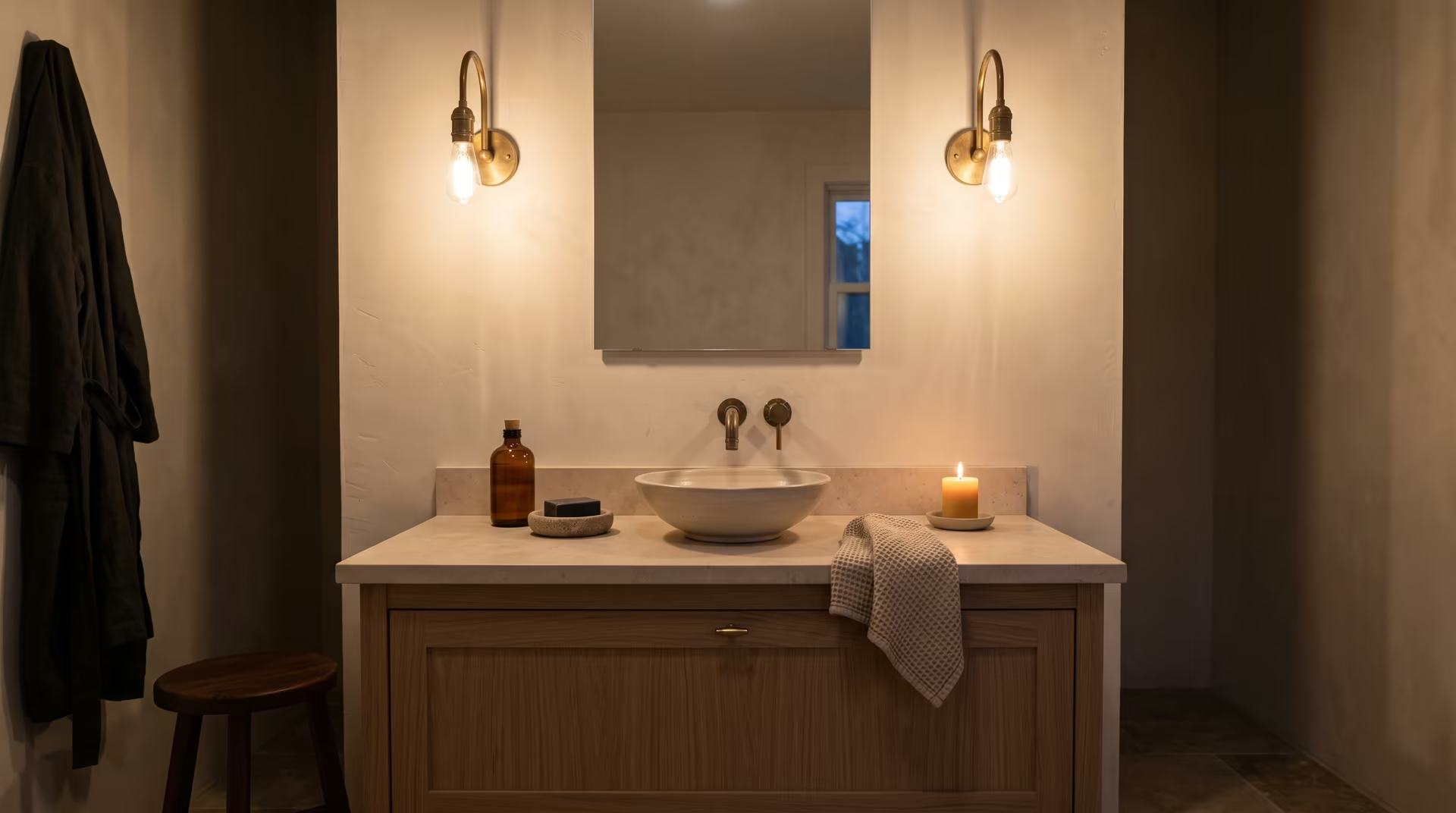
Three sources is the target: one ambient (overhead, dimmed low), one task (flanking the mirror), one accent (a floor-level plug-in, a niche strip, or a lamp if the room allows). A bathroom with a lamp in it immediately stops reading as a utility room.
Sconces on either side of the mirror are the change people notice most and expect least. If rewiring is out of the question, plug-in sconces with cord covers do most of the work.
Reduce the Number of Visible Objects
This is free and it outperforms most purchases.
Count what is currently on your counter and your shower shelf. In a hotel bathroom that number is usually under six. In a normal home bathroom it is somewhere past twenty-five: three shampoos, a razor, a hairbrush, a candle nobody lights, four bottles that are almost empty.
The rule that works: nothing on the counter that is not used daily, and nothing in the shower in its original packaging. Decant what you use into matching bottles, put the rest in a drawer, and throw away the almost-empty ones. Amber glass, frosted glass, or simple white ceramic — the point is uniformity, not expense.
Storage has to absorb what you remove, or it comes back within a week. A drawer organizer, a closed cabinet, or a lidded basket under the sink. This is the least glamorous item on the list and the one that determines whether the rest of it holds.
Choose Materials That Age Well
Spa interiors are built from a short list of materials, and the list has not changed much in twenty years because it works: stone, wood, plaster, unglazed ceramic, linen, and metal that is allowed to patina.
What they share is that they look better after two years than on day one. The materials that undermine the effect are the ones engineered to look perfect and then fail visibly: high-gloss laminate, chrome-plated plastic, printed vinyl.
Small material swaps with outsized effect
- Unlacquered brass or living-finish fixtures instead of polished chrome. They darken and warm over time.
- A stone or wood tray on the vanity to corral the few things that stay out.
- Limewash or clay paint on one wall if you are painting anyway. The depth is visible in a way flat latex is not.
- A teak or oak bath mat instead of a fabric one. It drains, it does not hold damp, and it reads as architecture rather than laundry.
Upgrade the Water Itself
The most overlooked spa upgrade is the water, and it is a genuine one.
Showerhead. The federal maximum in the United States is 2.5 gallons per minute, with California and a few other states at 1.8. Within that limit there is an enormous quality range. A well-engineered head at 1.8 gpm can feel better than a cheap one at 2.5, because the difference is in droplet size and distribution rather than volume. Rain heads look magnificent and, for anyone with long hair, are often disappointing in practice — consider a rain head paired with a handheld on a diverter.
Thermostatic valve. This is the hotel detail nobody names. A thermostatic mixing valve holds the temperature steady when a toilet flushes elsewhere in the house, and lets you set your preferred temperature once. It is a plumbing job, not a fixture swap, but it is the cheapest plumbing job on this list.
Filtration. If you live somewhere with hard water, an inline shower filter changes how your skin and hair feel more than any product will. Replace the cartridge on schedule or it does nothing.
Textiles Are Where the Money Should Go
Nothing else on this list gives you as much sensory return per dollar.
| Item | What to look for | Rough cost |
|---|---|---|
| Bath towels | 600–700 GSM cotton, or Turkish cotton for faster drying | $30–70 each |
| Bath sheet | One per person, larger than you think | $50–90 |
| Robe | Waffle weave for warm climates, terry for cold | $80–200 |
| Bath mat | Cotton, heavy, or wood as above | $40–80 |
Two rules. Buy fewer, better. Four excellent towels beat twelve mediocre ones, and they will fit in the cabinet. Buy them all the same. Mismatched towels are the single loudest signal that a bathroom is not a spa.
Wash new cotton before first use, skip fabric softener entirely — it coats the fibers and destroys absorbency — and use half the detergent you think you need.
Add Something Living
Every spa interior you have admired had plants in it. Bathrooms are unusually good growing environments: humid, stable in temperature, often bright enough.
What survives real bathrooms:
- Pothos — tolerates low light, nearly impossible to kill, trails from a high shelf
- Boston fern — loves the humidity, dramatic, wants consistent moisture
- Snake plant — for windowless bathrooms, needs very little
- Staghorn fern — mounted on wood, sculptural, the one people ask about
- Eucalyptus — a bundle tied to the showerhead, replaced monthly, for scent rather than horticulture
If the room has no natural light at all, a single high-quality faux plant in a real ceramic pot is better than a dead real one. One, not several.
Warmth Underfoot and on the Towel Rail
Heat is the detail that separates a nice bathroom from one that feels expensive, and it is the reason hotel bathrooms feel different in winter.
A heated towel rail costs between $150 and $600 and runs on a standard outlet in plug-in versions. A warm towel after a shower is a disproportionate pleasure for the money, and it dries towels properly between uses, which solves the mildew problem at the same time.
Radiant floor heating is a renovation-only item, installed under new tile, typically $10 to $20 per square foot. If you are already retiling, add it. If you are not, do not tear up a floor for it.
A small space heater on a timer is the budget version of both. Less elegant, entirely effective.
Control Sound and Smell
Two senses that get no attention and do a great deal of work.
Sound
The exhaust fan in most homes is loud enough to prevent the room from ever feeling calm. Fan noise is measured in sones — anything at 1.0 sone or below is genuinely quiet, and most builder-grade fans are at 3.0 or worse. Replacing one is a straightforward job and it changes the room completely.
Soft surfaces help too. A heavy mat, a fabric shade instead of a plastic blind, a towel on a hook rather than a bare wall — all of it takes the echo down.
Smell
Scent should be low and consistent rather than strong and floral. A single scent for the room, not three competing ones.
Options in ascending order of commitment: a bundle of eucalyptus in the shower, a good candle lit only when the room is in use, reed diffusers with a natural oil base, or an ultrasonic diffuser on a timer. Whatever you choose, keep the same scent for months. Recognition is the effect you want.
Build In Somewhere to Sit
This is the one full-renovation item, and it is what genuinely separates a spa bathroom from a well-styled one.
A bench in a shower, a stool beside the tub, a chair in the corner if the room is large enough. It changes what the room is for. A bathroom you stand in is a functional room. A bathroom you sit in is somewhere you spend time.
If you are building: a floating teak bench in the shower, wide enough to be useful, with the shower controls reachable from a seated position. If you are not: a freestanding teak stool costs under $100, needs no permission, and does most of the same work.
The same logic applies to the tub surround. A ledge wide enough to hold a book, a cup, and a candle is the difference between a bath you take and a bath you look forward to.
Common Questions
How do I make a small bathroom feel like a spa?
Reduce the object count first, then fix the lighting. Small rooms are punished harder by clutter and harsh light than large ones. Avoid dark grout and busy patterns, use a single material family, and hang the mirror as large as the wall allows.
What colors work best in a spa bathroom?
Warm neutrals with a natural material as the accent: off-white, greige, sand, clay, soft taupe. The spa look is about the absence of visual noise rather than a specific color, so restraint in the palette matters more than the shade you choose.
Can I do this in a rental?
Most of it, yes. Lighting bulbs, plug-in sconces, showerhead, filter, textiles, plants, stool, storage, scent, towel warmer — none of it requires permission or permanent change. Keep the original showerhead in a box for move-out.
What is the cheapest change with the biggest effect?
Swapping to 2700K high-CRI bulbs and adding a dimmer, then clearing the counter. Together that is under $60 and it alters the room more than a new vanity would.
How much does a spa bathroom renovation cost?
A full remodel in the United States generally runs $15,000 to $35,000 depending on region and scope, with high-end builds going well past that. Everything in this article outside of the shower bench and radiant floor sits well under $2,000 combined, which is why it is worth doing that first and deciding afterward whether you still want the renovation.
Do I need a bathtub for a spa bathroom?
No. A large walk-in shower with a bench, good water pressure and a steam function delivers the same experience, and it is the direction most hotel design has moved. Put the space into the shower rather than into a tub you will use four times a year.
Keep Reading
- Japandi Bathroom: The Look, and How It Works in a Small Space — One specific direction to take the look, and it suits small rooms.
- Soaking Tubs and Freestanding Baths: What to Know Before You Buy — If a tub is part of the plan, check these five numbers first.
- How to Create a Wellness Room in a Space You Already Have — The same principles applied to a room outside the bathroom.