The generator is the number everyone quotes, and it is usually a third of the budget or less.
That is the central fact about steam room pricing. The appliance that makes the steam — a well-made residential unit from Mr. Steam, ThermaSol, Steamist or Kohler — runs roughly $1,000 to $3,000. Everything around it, the sealed and waterproofed room that makes steam usable indoors, is construction, and construction is priced by the square foot, the hour and the region you live in.
That is why home steam room cost figures range from a few hundred dollars to a full remodel budget: the appliance is a rounding error next to the room around it.
Below is the full accounting for each route: the portable tent, the prefab cabin, the shower conversion and the dedicated custom build, with the line items that actually move the total. Figures are United States ranges for 2026 and swing considerably by region and by contractor, so plan against the ranges rather than treating them as quotes.
The Short Answer, by Route
| Route | All-in cost | What you get |
|---|---|---|
| Portable steam tent | $150–600 | A fabric sauna-style tent with a small steamer |
| Prefab steam shower cabin | $4,000–10,000 | Freestanding acrylic unit, generator built in |
| Shower conversion | $8,000–20,000 | Your walk-in shower, rebuilt as a sealed steam enclosure |
| Dedicated custom steam room | $15,000–35,000+ | A purpose-built tiled room |
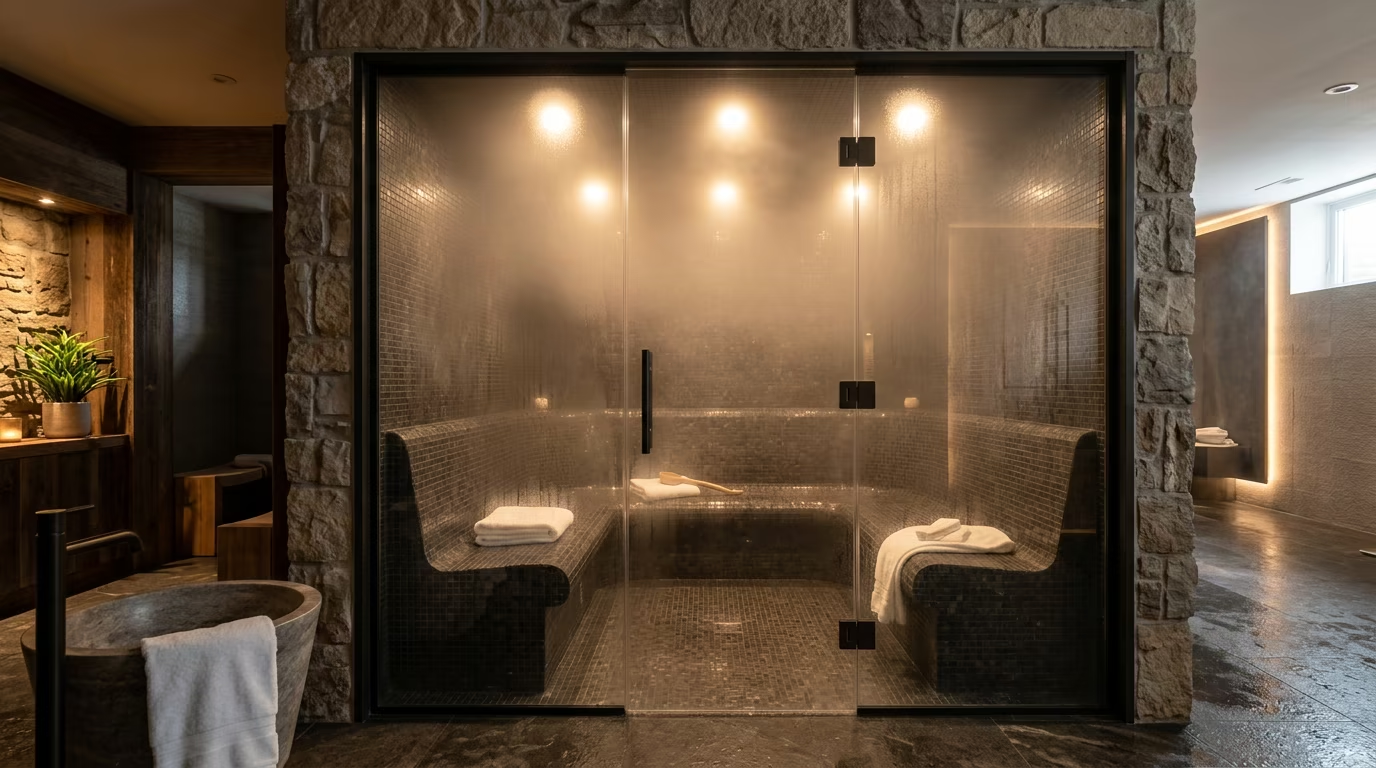
Two honest notes on the ends of that table. The portable tent is real steam and costs almost nothing, but it is a tent — you sit in it with your head out, and it has more in common with a sauna blanket than with a steam room. The custom build is the version in the photographs, and its price is a construction project’s price for a reason: it touches framing, waterproofing, tile, glass, plumbing and electrical in the same 20 square feet.
Most readers land on the middle two rows, and most of this article is about them.
The Generator
The one component with a stable price.
| Item | Cost |
|---|---|
| Residential steam generator, 4.5–9 kW | $1,000–3,000 |
| Control and steam head | usually included |
| Auto-flush system | $200–500 |
| Aroma or chromotherapy add-ons | $100–600 |
Sizing is by cubic footage of the enclosure, adjusted for wall material. A 3-by-4-by-7-foot room is 84 cubic feet, which calls for a small unit — unless you tile it in natural stone, which absorbs so much heat that manufacturers tell you to roughly double the effective volume. This is the sizing mistake people make most, and an undersized generator is the one error you cannot fix without replacing the unit. Use the brand’s own sizing chart — all of the major ones publish one — and round up when you are between sizes.
The auto-flush option is worth the money in hard-water areas. It drains the tank after each session and stretches the descaling interval from months to years.
The Enclosure and Tile Work
For conversions and custom builds, this is the largest single category, and it is priced like a high-end shower because that is what it is.
| Component | Cost |
|---|---|
| Framing, backer board, sloped ceiling build-out | $1,000–3,500 |
| Tile and setting, walls and ceiling | $3,000–10,000 |
| Custom frameless glass door and panel, gasketed | $1,500–4,000 |
| Built-in bench, tiled | $800–2,500 |
The tile line varies enormously because tile itself varies enormously — plain porcelain at a few dollars a square foot against stone at twenty or more. But note what does not vary: you are tiling floor, all walls and the ceiling, not just a wet wall. A steam enclosure has roughly double the tiled surface of an equivalent shower, and the ceiling is the slowest, least pleasant surface to set, so labor tracks area accordingly.
The door is not a place for a standard shower door. Steam doors are gasketed, with a sweep and a seal at every edge, and the glass is typically operable transom or vented panel territory if you want to let the room breathe afterward. Expect custom glazing pricing.
Waterproofing: The Line Item People Skip
Not skipped on the invoice — skipped in the sense that bids quietly assume shower-grade waterproofing where steam-grade is required.
A steam room needs a continuous vapor-rated membrane over every surface, floor to ceiling, with sealed penetrations at the steam head, lights, niches and door frame. Products rated for steam duty cost more than standard shower membranes, and the labor is meticulous rather than fast. Budget $800 to $2,500 for membrane and detailing on a typical enclosure, and treat any bid that does not name the membrane product and its steam rating as unfinished homework.
This is also the line where the false economy is most expensive. A vapor leak into a wall cavity does not show up for a year or two, and when it does, the repair is demolition. The $1,500 membrane is the cheapest insurance in the entire project.
Plumbing and Electrical
Both are modest in scope and easy to underestimate.
| Work | Cost |
|---|---|
| Water line and drain connection for generator | $300–1,000 |
| Dedicated 240V circuit, panel nearby | $500–1,500 |
| Long run or difficult access | $1,000–2,500 |
| Panel capacity work, if needed | $2,000–5,000 |
The generator needs cold water and a drain within about 25 feet of the steam head, which is why generators so often land in the vanity, a nearby closet or the basement below. Electrically, a residential unit draws on the order of a large appliance — typically a dedicated 240V circuit at 30 to 50 amps depending on size. Most modern panels absorb that without drama; older 100-amp services may not, and finding that out early is what a pre-purchase service call is for.
If your steam room shares a wall with the bathroom plumbing, plumbing costs stay at the low end. A generator located two rooms away can double them.
Labor: The Big Variable
Steam room labor is not one trade, and that is what makes estimates swing. It is also the biggest driver of the total cost of steam room construction — the generator price barely moves while labor doubles or halves.
A conversion or custom build sequentially involves a carpenter for framing and the ceiling slope, a waterproofing and tile crew, a glazier for the door, a plumber for the generator hookup and an electrician for the circuit. In a full-service remodel this is one general contractor’s number; managed trade by trade it is four or five separate minimums, each of which applies even to a small room.
| Route | Typical labor share |
|---|---|
| Prefab cabin placement | $500–2,000 |
| Shower conversion | $5,000–12,000 |
| Custom build | $8,000–18,000 |
Regional variation is extreme — the same conversion can be quoted at half again as much in a coastal metro as in the Midwest. Three bids is the standard advice, and here it is genuinely informative, because the spread tells you which contractors have actually built a steam enclosure before. Ask each bidder directly how many they have done. Steam rooms are a specialty hiding inside a general trade, and the learning curve is paid for by whoever hires the learner.
Permits and Inspections
Unexciting and mostly cheap, with one rule worth keeping.
The electrical work almost always needs a permit, and the plumbing hookup frequently does. The room itself, when it is a remodel inside an existing bathroom, usually needs no structural permit at all. A dedicated new room in a basement finish or addition falls under whatever permits that larger project carries.
Budget $100 to $600 in permit fees for a typical conversion. The rule: unpermitted electrical work is the kind of thing that surfaces during a home sale inspection and then costs triple to remediate under time pressure. Permit the circuit. It is the least interesting money in the budget and among the best spent.
What It Costs to Run
Pleasantly boring, which is why people who own steam rooms actually use them.
A residential generator draws its rated power while producing steam and cycles once the room is at temperature. A 20 to 30-minute session, including warm-up, consumes roughly 1.5 to 4.5 kilowatt-hours depending on generator size and room volume. At a national average electricity rate of around 17 cents per kWh, that is 25 to 75 cents per session. Water use is a few gallons — less than the shower most people take afterward.
| Generator | Per 30-min session | Daily use, per year |
|---|---|---|
| 4.5–6 kW | $0.25–0.45 | $90–165 |
| 7.5–9 kW | $0.40–0.75 | $145–275 |
Maintenance adds a little: descaling the generator two to four times a year in hard-water areas (vinegar or the manufacturer’s solution, an hour of your time, near-zero cost), re-caulking a joint occasionally, and re-sealing natural stone if you chose it. Call it under $100 a year in a well-built room. The rooms that get expensive to maintain are the ones where the envelope was underbuilt — which is, again, the waterproofing section.
Where People Overspend and Where to Save
Worth paying for
- A correctly sized generator. The only irreversible decision on the equipment side. Use the brand’s chart, account for stone, round up.
- Steam-rated waterproofing, fully detailed. The cheapest insurance in the project and the most expensive thing to retrofit.
- The glass door. A properly gasketed custom door is the difference between a steam room and a warm fog machine that leaks into your bathroom.
- A bench you can actually sit on. Four feet long, 18 inches deep, sloped to shed water. Comfort is adherence.
- The electrician’s pre-purchase service call. One hour that prevents the worst surprise in the budget.
Usually not worth it
- Chromotherapy lighting packages. Colored LEDs at a markup. A single dimmable, wet-rated warm light does the same job.
- Aromatherapy pumps and fragrance systems. A few drops of eucalyptus oil on the steam head diffuser or in a corner cup works nearly as well for nearly nothing.
- Premium stone throughout. Beautiful, porous, cold to start, expensive to seal, and it doubles your generator requirement. Use it as an accent if you love it.
- Built-in audio. Steam and speakers have a short relationship. A waterproof portable speaker outside the door sounds fine and dies later.
- Oversizing the room. Every extra cubic foot costs generator, tile, waterproofing and heat-up time, forever. Build the smallest room that fits the bench you want.
The genuine budget route
If the goal is steam itself rather than the room: a prefab steam cabin in an existing bathroom, or — honest answer — a $150 to $600 portable steam tent to test whether you will actually use steam three times a week. If the habit holds for six months, the conversion pays for itself in use. If it does not, you have saved yourself a five-figure remodel and you know it now rather than after the tile is set.
Common Questions
What does steam room installation cost on its own?
Steam room installation — labor, plumbing and electrical, without the room’s finishes — typically runs $6,000 to $15,000 of an $8,000 to $20,000 shower conversion. Labor is the majority of any steam project, because four or five trades touch a very small room.
What is the cheapest way to get steam at home?
A portable steam tent at $150 to $600, or a prefab steam shower cabin at $4,000 to $10,000 placed in an existing bathroom. Both avoid construction; the cabin is the better experience, the tent is the better experiment.
Is a steam shower cheaper than a dedicated steam room?
Substantially. The steam shower cost stays low because a conversion reuses the footprint, drain and plumbing of an existing shower, which removes framing and much of the plumbing from the budget. Expect a dedicated room to cost roughly half again to twice as much as a comparable conversion.
How much does a steam room cost to run?
About 25 to 75 cents per session in electricity at average rates, plus a few gallons of water and under $100 a year in maintenance. Running cost is negligible compared to the build, which is the correct way around.
Does a steam room add value to a home?
Not in a way appraisers reliably price. A well-built steam shower reads as a luxury bathroom and helps a listing photograph well; a dedicated steam room is a niche feature. Build it for use, not for resale.
Why are steam room quotes so far apart?
Because the trade mix and the waterproofing standard vary, and some bidders have built steam enclosures before and some have not. Ask each contractor how many they have done and what membrane they specify — the two questions that explain most of the spread.
Keep Reading
- Home Steam Room: What It Actually Takes to Build One — Space, envelope, ceiling slope and equipment placement before you price it.
- Portable Steam Room: What the Tent-Style Options Actually Deliver — The sub-$600 route, honestly assessed.
- What a Home Sauna Actually Costs — The dry-heat budget, if you are still choosing between the two.